

A Guide to Your First Content Audit Website Analysis
So, what exactly is a content audit? Think of it as a strategic review of every single piece of content on your website, from product pages to blog posts. The whole point is to figure out what's working, what's falling flat, and what needs a serious tune-up to help you hit your business goals—like better SEO rankings from services like blog posting and article writing, and of course, more sales.
Why Your Restaurant Equipment Site Needs a Content Health Check

If you're trying to sell more charbroilers, just having product pages isn't going to cut it. In this market, your website can't just be a digital catalog. It needs to be a rich library of genuinely useful content that pulls in restaurant owners and chefs, keeps them around, and convinces them to buy. This is where a content audit, often a key part of our SEO services for restaurant equipment suppliers, becomes your most powerful tool.
Consider it a full physical for your online presence. It’s the difference between guessing what your audience wants and knowing what actually drives sales. Without this kind of deep dive, you could be sinking time and money into blog posts nobody reads or, worse, maintaining product pages that are actively hurting your Google rankings.
Pinpointing Wins and Losses
A content audit uncovers the real stories hidden in your website data. You might find that a forgotten blog post on "smoky flavor techniques" is a magnet for chefs who are the perfect customers for your floor model charbroilers. On the flip side, you could discover that your flagship modular charbroiler page gets virtually no organic traffic because its SEO is a mess.
This process gives you clear answers to mission-critical questions:
- Which pages are bringing in the most qualified traffic from restaurant managers?
- Is our content actually speaking to the different needs of a local diner versus a high-end steakhouse?
- Are there outdated articles or thin product descriptions dragging down our SEO?
- What content gaps are our competitors exploiting right now?
A strategic content audit isn’t just about spring cleaning. It’s about pouring a stronger foundation for real, sustainable growth. It turns your website from a simple product list into a high-performance sales machine that works around the clock.
From Analysis to Actionable Roadmap
The real magic of an audit is the clear, actionable roadmap it leaves you with. No more randomly writing articles or tweaking headlines and hoping for the best. Instead, you get a plan backed by hard data. You'll know exactly which pages to update, which ones to merge for more impact, and which low-value pages to cut loose to boost your site's overall quality.
For a deeper look into the technical side of things, our guide on how to do a site audit is a perfect complement to the content-first approach we're talking about here.
For instance, your audit might reveal two separate, weak articles—one on "getting perfect grill marks on sandwiches" and another on "grilling vegetables." By combining them into one comprehensive guide, a task our copywriting and article writing team excels at, you create a powerhouse piece with a much better shot at ranking and becoming a go-to resource.
Ultimately, running a content audit on your website is the single best way to understand what truly connects with your audience. It makes sure every piece of content, from your homepage to your latest blog post, is pulling its weight to boost visibility, drive high-quality traffic, and sell more restaurant equipment.
Defining Your Audit Goals and Gathering the Right Tools
Jumping into a full-scale content audit without a clear goal is like trying to cook a five-course meal without a recipe. You might end up with something, but it almost certainly won't be what you had in mind. The first and most critical step is to get past vague wishes like "get more traffic" and define what success actually looks like for your business.
What business outcome are you really trying to achieve? For a restaurant equipment supplier, your goals need to be specific and measurable. Instead of just "more traffic," you should be aiming for something like, "increase qualified leads for floor model charbroilers by 15% in the next quarter." See the difference? That immediately gives your audit a sharp focus.
Another powerful goal might be to dominate the SEO rankings for a key product category. For example, your objective could be to "rank on the first page of Google for 'best commercial charbroiler for diners' within six months." When you set precise targets like these, your audit transforms from a simple inventory check into a strategic mission.
Setting Meaningful KPIs
Once you’ve nailed down your primary goals, it's time to choose the Key Performance Indicators (KPIs) that will track your progress. These are the hard numbers that tell you if your content is actually pulling its weight. You’ll be pulling most of this data directly from tools like Google Analytics and Google Search Console.
Let's break down the essential metrics you'll want to watch.
Essential Metrics for Your Restaurant Equipment Content Audit
| Metric | What It Tells You | Where to Find It |
|---|---|---|
| Organic Traffic | How many people are finding your page through search engines. A great indicator of SEO health. | Google Analytics / Google Search Console |
| Keyword Rankings | Your page's position in Google for specific, important search terms. | Google Search Console / SEO Tools |
| Average Time on Page | How long visitors are sticking around. Low time on page can signal boring or irrelevant content. | Google Analytics |
| Bounce Rate | The percentage of visitors who leave after viewing only one page. High bounce rates often mean a poor match between the user's search and your content. | Google Analytics |
| Quote Requests | A direct measure of how well your content converts visitors into potential customers. | Google Analytics (Goal Completions) |
| PDF Spec Sheet Downloads | Shows high-intent engagement; these users are likely in the consideration or decision phase of buying. | Google Analytics (Event Tracking) |
| Backlinks | The number of other websites linking to your content. A key factor for building authority with Google. | Google Search Console / SEO Tools |
Keeping a close eye on these specific metrics ensures your content audit is directly tied to what actually matters—selling more equipment.
Every decision you make from here on out—whether to update a blog post or delete a product page—should be guided by its potential to move these numbers in the right direction.
Assembling Your Audit Toolkit
Here’s some good news: you don't need to spend a fortune on complicated software to run a powerful content audit. You can get a huge amount done with a few essential, mostly free tools that you probably already use.
The heart of your operation will be a simple spreadsheet. Seriously. A Google Sheet or Excel file is all you need to create your content inventory. This document will become your command center, listing every single URL on your site and housing all the data you collect.
To fill that spreadsheet, you'll lean on two workhorse tools:
- Google Analytics (GA4): This is your source for all user behavior data. For each URL, you'll pull metrics like Page Views, Unique Users, Average Engagement Time, and Conversions.
- Google Search Console (GSC): This tool gives you indispensable SEO insights. For every page, you’ll grab data on Clicks, Impressions, Average Position in search results, and—crucially—the exact queries people used to find that page.
Once you have your spreadsheet set up with columns for each of these KPIs, you can start pulling the data. This foundational work gives you a clear, data-backed picture of your entire website and sets the stage for a truly effective analysis. To help you with this, feel free to learn more about how to build a keyword list in our article to better inform your audit.
Analyzing Your Content for SEO and User Experience

Alright, you’ve got your goals locked in and a spreadsheet loaded with data. Now the real work begins. This is where you put on your detective hat and start asking the tough, qualitative questions about every page on your restaurant equipment site.
This part of your content audit website review is all about looking at two sides of the same coin: how well you’re pleasing the search engines, and how well you’re serving the actual chefs and managers you want as customers.
It’s not enough to just tick a box saying a product page has a title tag. You need to go deeper. Think like your customer for a minute. Does your guide on getting the perfect sear with a new charbroiler actually solve a real problem for a line cook, or is it just fluff? Does your content sound like it was written by someone who knows their way around a commercial kitchen, or is it generic? Answering these questions honestly is what separates a decent website from a truly great one.
Assessing On-Page SEO and Technical Health
Let’s start with the technical nuts and bolts. Every single piece of content, from your most popular blog post to a brand-new product page for a countertop charbroiler, needs a solid technical foundation. This is how search engines find, understand, and rank your stuff.
Your first pass should be a sweep for common SEO red flags that might be holding you back.
Systematically check every important page for these basics:
- Optimized Metadata: Do your title tags and meta descriptions exist? Are they unique and compelling enough to make someone click?
- Logical Heading Structure: Is the content broken up with a clear hierarchy of headings (H1, H2, H3)? This helps both people and search crawlers follow along.
-
Clean URL Slugs: Keep your URLs short, sweet, and descriptive. For example,
/floor-model-gas-charbroiler-36-inchis a world away from/product-id-789-fgc. - Image Optimization: Every image needs descriptive alt text. It’s crucial for accessibility and gives search engines more context about the page.
As you go, benchmark your content against current SEO content writing best practices. You can have the most brilliant information on a page, but if the technical signals are a mess, it’s going to have a hard time getting seen.
Identifying Content Decay and Underperformers
Content isn't a "set it and forget it" deal. Even your star players can start losing steam over time. We call this content decay, and sniffing it out is one of the main goals of an audit.
Scan your spreadsheet for pages that used to bring in solid traffic but have been on a steady decline for the last 6-12 months. These are your golden opportunities for a refresh. A blog post titled "The Top Charbroilers of 2022" is a perfect example—it was great then, but now it's just old news. Flagging these for an update is one of the easiest wins you'll get from this whole process.
While you're at it, you can give them a technical SEO tune-up by following our complete guide to on-site optimization.
Don't just look at what's broken; look for what's fading. Reviving a piece of content with strong historical performance is often easier and more effective than creating something entirely new from scratch.
Weeding Out Thin and Duplicate Content
Not all content is good content. In fact, some of it might be actively hurting your site's authority. Two of the biggest offenders you need to hunt down are thin content and duplicate content.
Thin content is exactly what it sounds like: pages that offer little to no real value. Think product pages with a single-sentence description, old 100-word blog posts, or auto-generated category pages with zero unique text. Google wants to see depth and quality, and a site bloated with thin pages can find itself penalized.
Duplicate content happens when you have big chunks of text that are identical or nearly identical on different URLs. This confuses search engines, forcing them to guess which page to rank and ultimately diluting the power of both. It's a common trap in e-commerce, where product descriptions get copied and pasted across similar models.
Evaluating Content Quality and User Intent
Okay, time to step back from the technical weeds and look at each page like a real person would. This might just be the most important part of your analysis. For every key page, ask yourself these three questions:
- Does It Match Search Intent? If someone searches "gas vs electric charbroiler," are they ready to buy, or are they looking for a detailed comparison guide? Make sure the type of content you're offering matches what the user is actually looking for.
- Is It Authoritative and Trustworthy? Does your content sound like you know what you’re talking about? For a restaurant equipment site, that means giving specific details, professional tips, and clear specs that a chef would actually find useful.
- Is It Engaging and Easy to Read? Is the page just a giant wall of text? Or is it broken up with short paragraphs, helpful images, and clear headings? A bad user experience sends people bouncing right back to the search results, which is a major red flag for Google.
Uncovering Content Gaps and New Opportunities

Alright, you’ve meticulously analyzed every piece of content you already have. Now it's time to shift your focus to what's missing. This is where your content audit website analysis gets really interesting—you stop being a content editor and become a strategic opportunity hunter. You're searching for the gaps, the questions your customers are asking that you're not yet answering.
Think of it this way: your existing content is based on what you think your customers want to know. A content gap analysis uncovers what they are actually searching for right now. For a restaurant equipment supplier, this means getting inside the heads of chefs, diner owners, and food service managers to tackle their real-world, specific problems.
The goal here is simple: find valuable, low-competition topics that will pull qualified buyers directly to your website.
Analyzing Competitor Content Strategies
One of the fastest ways to find gold is to see what's already working for your rivals. By digging into the content your direct competitors are ranking for, you can essentially reverse-engineer their success and spot the topics you’ve completely overlooked.
Using effective competitor AI analysis tools can give you a serious edge here. These platforms can quickly show you keywords and topics where your competitors are strong, but you have no presence at all.
Look for the specific, niche topics they're owning that you aren't even touching. You might discover a competitor ranks highly for things like:
- Maintenance tips for floor model charbroilers
- A detailed comparison of gas vs. electric charbroilers for small bistros
- How to achieve authentic char-grilled flavor on a countertop model
- Sanitation best practices for commercial kitchen grills
These aren’t just random blog post ideas. They are proven topics that attract the exact audience you need. Each one represents a hole in your content strategy that you can now strategically fill.
Mining for Customer Questions
Beyond just spying on your competition, you need to go directly to the source to understand what your potential buyers are thinking. Your mission is to find the exact language they use when searching for solutions. This ensures any new content you create will perfectly match their search intent.
The most powerful content ideas come directly from the problems your customers are trying to solve. Your job isn't to invent topics; it's to listen for them and provide the best answers.
Imagine you're running a bustling sandwich shop, where every online visitor could turn into a loyal customer ordering a perfectly char-grilled burger from your equipment. However, a startling fact from 2026 SEO data shows that a whopping 60% of Google searches now result in zero-click outcomes. Users are finding their answers in AI summaries without ever visiting sites like yours. This shift is precisely why a thorough content audit for your website, focused on answering specific questions, is no longer optional.
Finding High-Value Content Ideas
The good news is, you can uncover these valuable questions using free and accessible resources. These methods give you a direct line into the real conversations your target audience is having every single day.
- Google's "People Also Ask" (PAA): Search for a primary keyword like "commercial charbroiler" and scroll down to the PAA box. This is a goldmine of related questions that real users are typing into Google, like "How do you clean a commercial charbroiler?" or "Can you use cast iron on a charbroiler?"
- Industry Forums and Q&A Sites: Websites like Reddit (check out subreddits like r/Chefit or r/KitchenConfidential) and Quora are packed with professionals discussing their daily challenges. A quick search will reveal unfiltered questions about equipment maintenance, purchasing decisions, and cooking techniques.
- Review Your Own Customer Service Data: This is a hugely underrated tactic. Talk to your sales and support teams. What are the most common questions they get from potential buyers on the phone or via email? These FAQs are the perfect foundation for high-value blog posts, guides, or dedicated FAQ pages.
By the end of this process, you should have a solid list of data-backed, customer-focused content ideas. This isn't just a list of potential blog titles; it's a strategic roadmap for creating content that fills critical gaps, outmaneuvers your competition, and attracts highly qualified buyers to your equipment site.
Turning Your Audit into an Action Plan
Alright, you’ve done the heavy lifting. You’ve wrestled with spreadsheets, stared at analytics, and now you have a complete picture of your website’s content. This is where the real work begins—transforming all that raw data into a clear, decisive strategy. Your content audit has shown you what’s working, what’s failing, and what’s just… there. Now, it’s time to make some calls.
You don't need a complicated system for this. In fact, the simpler, the better. Every single piece of content on your restaurant equipment site is about to get a new job title.
The Four Content Fates: Keep, Update, Consolidate, or Kill
Your goal here is to assign one of four simple actions to every URL in your inventory: Keep, Update, Consolidate, or Remove. This isn't about guesswork; it's about creating a tangible roadmap your team can actually follow. This is how an audit delivers real results.
Let’s dig into what each of these means.
- Keep: These are your all-stars. The content is pulling in traffic, ranking for valuable keywords, and perfectly aligns with what your customers need. Don’t touch it. Just let it do its thing.
- Update: This pile is for content with great bones but some obvious flaws. Maybe it's a popular blog post with stats from five years ago, or a product page that gets traffic but has a terrible bounce rate. It has potential, it just needs some TLC.
- Consolidate: This is for all the thin, overlapping content you found. Think two separate, weak articles—one on charbroiler maintenance and another on cleaning your griddle—that could be combined into one powerhouse guide.
- Remove: The dead weight. This is for content that's outdated, totally irrelevant, and adds zero value. These pages usually have next to no traffic, no engagement, and no decent backlinks. It's time to say goodbye.
This simple four-part framework is what turns a messy spreadsheet into an organized, prioritized to-do list. It’s the critical bridge between analyzing data and taking actions that actually drive revenue for your restaurant equipment business.
The Big Question: Update or Consolidate?
Figuring out whether to update a page or merge it with another is a common sticking point. For a restaurant equipment supplier, it usually boils down to specificity and what the customer was looking for in the first place.
Take a blog post you wrote titled "Top 5 Gas Charbroilers of 2022." It’s still getting decent traffic, but it's obviously dated. This is a classic Update candidate. The topic is solid and it already has some SEO juice. The path forward is clear: refresh it with current models, slap "2026" in the title, and maybe add some new buying tips.
Now, let's say you uncover two separate, low-traffic articles: one on "How to Get Perfect Grill Marks on Paninis" and another on "Grilling Vegetables for Your Catering Menu." Neither is strong enough to stand on its own. These are begging to be Consolidated. Merge them into a single, killer guide like "Mastering Your Charbroiler: From Paninis to Veggies and Beyond." You'll create a much more valuable resource that can rank for a wider net of keywords.
Why Deleting Content is a Good Thing
I get it—it feels wrong to delete something you spent time creating. But pruning your site is one of the best things you can do for its overall health. Search engines value quality over quantity, period. A website bloated with thin, low-value pages can actually drag down the rankings of your best content.
Every page on your site needs to pull its weight. With mobile traffic projected to hit 60% of all web visits by 2026 and 46% of Google searches having local intent, your site needs to be fast and relevant. A deep content audit, combined with services like local citation building, helps you turn those mobile searches into sales by cutting the dead weight that slows everything down. You can find more insights on how modern website audits work and why users judge sites in seconds.
When you strategically remove outdated promotions, irrelevant blog posts, or pages for discontinued models, you’re sending a powerful signal to Google: "Hey, we're a curated source of high-quality, relevant information." This helps your best content shine even brighter.
By the time you're done with this step, your spreadsheet should have a new column: "Action." Every single URL will be assigned to one of those four categories. This document is no longer just an inventory—it’s your official, data-backed plan to make your website perform better.
Common Questions About Content Audits
After walking through an entire audit plan, it's totally normal to still have a few questions buzzing around. Especially when you're dealing with something as specific as restaurant equipment. Let's clear up some of the most common questions I hear so you can get started with confidence.
When it comes down to it, the whole process boils down to three simple choices for every piece of content you have: update it, consolidate it with something similar, or just get rid of it.
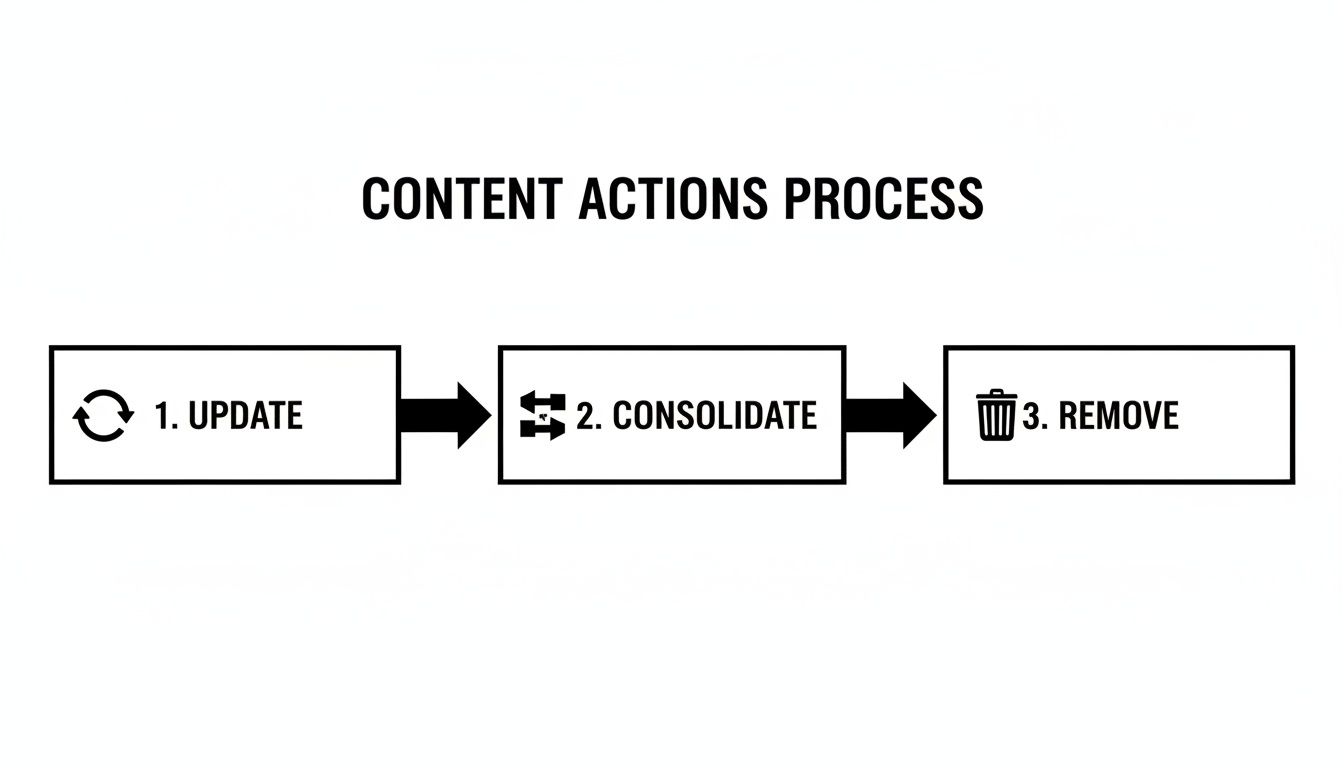
This flowchart really cuts through the complexity. It’s a direct, no-nonsense way to think about your decisions, turning what feels like a massive project into a manageable set of tasks.
How Often Should I Audit My Restaurant Equipment Website Content?
For a busy e-commerce site selling equipment like charbroilers, you'll want to do a major, deep-dive audit annually. Think of this as your big yearly physical—it gives you a solid baseline for your entire content strategy.
But you can't just set it and forget it for a year. I strongly recommend doing smaller, quarterly check-ins on your most important product pages and any new blog posts. This keeps you agile and lets you catch problems before they grow.
You should also plan on doing an immediate audit whenever a major event happens, like:
- A full site redesign goes live
- Google rolls out a significant algorithm update
- You see a sudden, scary drop in your organic traffic
These are red flags that demand a quick diagnosis. You need to figure out what's wrong and fix it before it does any real, long-term damage to your rankings.
By far, the biggest mistake people make is deleting content just because it has low traffic. A page might not get a ton of hits, but it could be ranking for super-valuable long-tail keywords, attracting a niche audience (like chefs hunting for a specific modular charbroiler feature), or holding some powerful backlinks, which blogger outreach services can help acquire.
Always dig into why a page is underperforming. More often than not, it just needs a content refresh or a few more internal links pointing to it—not a one-way ticket to the trash bin. Deleting assets without seeing the full picture can seriously hurt your site's authority.
Can a Content Audit Actually Help Sell More Charbroilers?
Yes, without a doubt. A properly executed content audit has a direct line to your sales numbers. When you improve your underperforming product pages and create new content that answers real customer questions (like "what's the best charbroiler for a small bistro?"), you start attracting more qualified buyers. Simple as that.
This all leads to higher rankings for commercial keywords, a steady stream of targeted traffic from restaurant owners ready to buy, and ultimately, more quote requests and sales. Your audit isn't just some technical SEO chore; it's a direct investment in your sales pipeline.
At Charbroilers.com, we know that the right equipment is the heart of any kitchen. Our expert team is here to help you find the perfect countertop, modular, or floor model charbroiler that will take your menu to the next level. See what a difference quality makes by exploring our full selection at https://charbroilers.com.