
Commercial Deep Fryer Buying Guide
A commercial deep fryer is a workhorse. It's the powerful kitchen appliance built for high-volume frying, turning raw ingredients into the crispy, golden-brown menu items your customers crave. But it's much more than just a piece of equipment; it's a critical profit center for any restaurant, responsible for producing some of the most popular and high-margin dishes you sell.
Why Your Commercial Deep Fryer Is a Profit Center
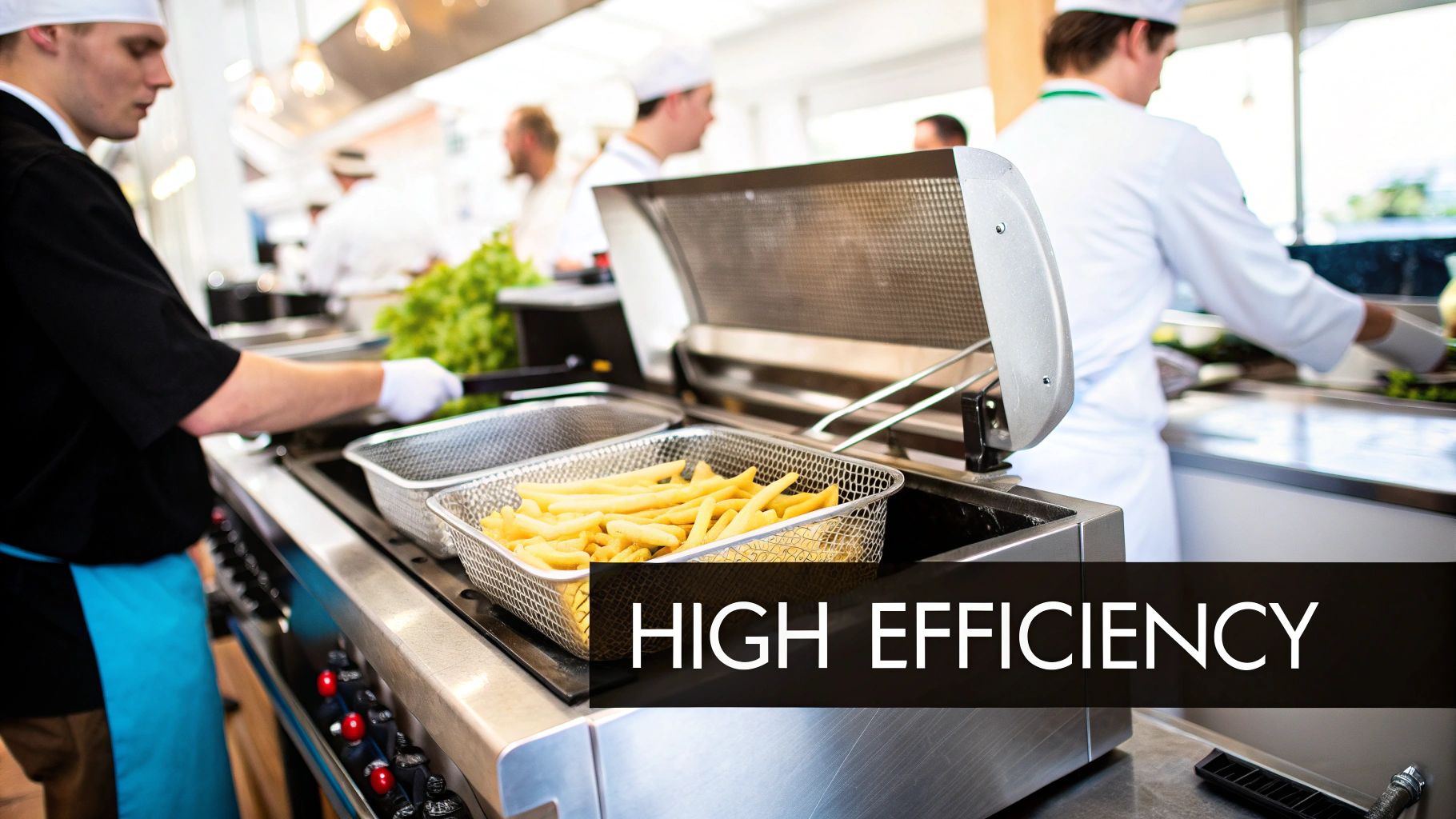
It's time to stop thinking of your deep fryer as just another appliance. Think of it as the engine driving a huge chunk of your menu's profitability. The right fryer pumps out delicious food that keeps customers coming back for more. The wrong one? It just leads to soggy results, wasted oil, and a whole lot of operational headaches.
This guide isn't about getting lost in technical specs. It's a strategic roadmap for your investment. Making a smart choice here is a core business strategy, and we'll show you exactly how to pick a model that quickly pays for itself in both efficiency and quality.
Connecting Frying with Financials
The link between a high-quality fryer and your bottom line is direct, and it's powerful. A well-chosen unit can ripple through your entire operation, turning would-be expenses into real savings while boosting revenue with a better final product.
- Operational Efficiency: The right model heats up fast and holds its temperature, letting your kitchen staff cook more food in less time without ever dropping the quality.
- Reduced Oil Costs: Smart features like built-in filtration systems and a "cold zone" can extend the life of your cooking oil by up to 50%. That's a massive cut to one of your biggest recurring costs.
- Product Consistency: A great fryer guarantees that every single batch of fries, wings, or tempura comes out perfectly cooked. This is what builds customer loyalty and protects your brand's hard-earned reputation.
An efficient commercial deep fryer isn't a cost; it's an investment in consistency. It guarantees that the hundredth order of fries is just as crisp and delicious as the first, which is the foundation of repeat business.
A Strategic Kitchen Investment
Ultimately, the goal is to see your fryer as a core part of your business strategy, not just a box that cooks things. We’re going to dig into how to match the right fryer type to your specific menu, pinpoint the features that will slash your labor and oil costs, and set up routines that protect your bottom line.
Just like compelling menu descriptions get customers to order, the right equipment ensures the food actually lives up to the hype. This guide will help you make a choice that doesn’t just improve your menu, but strengthens your entire financial operation.
Choosing the Right Fryer for Your Menu
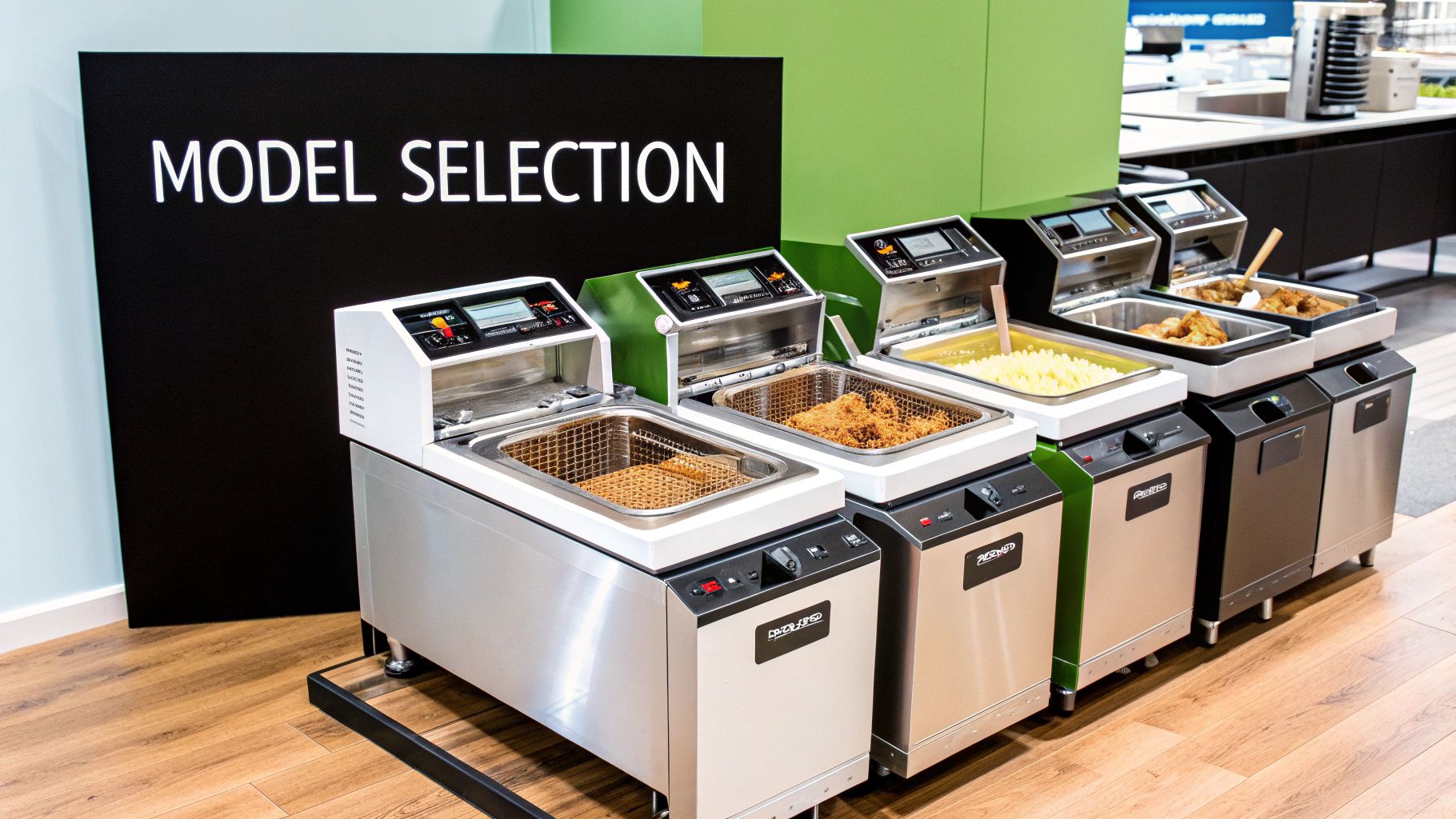
Picking the perfect commercial deep fryer isn't about grabbing the biggest, most powerful model you can find. It's about matching the equipment to your menu. The ideal fryer for a donut shop would be a terrible choice for a kitchen banging out breaded chicken, and vice-versa. To make a smart investment, you first need to understand the core differences in how these machines are designed and powered.
That journey starts with a simple choice: gas or electric? Each one brings its own strengths to the table and comes with different considerations for your kitchen's workflow.
Gas Versus Electric Fryers
A gas commercial deep fryer is the undisputed king of high-volume kitchens. These units heat up fast and have an even faster recovery time—that’s how quickly the oil temperature bounces back after you drop in a basket of frozen fries. That rapid response is what keeps your food crispy and your ticket times low during a crazy dinner rush.
But don't count electric models out. An electric commercial deep fryer usually gives you more precise temperature control, which is a lifesaver for delicate items. While their recovery time might be a bit slower, they're often more energy-efficient and can be much easier to install, especially if your building isn't already piped for gas.
The gas vs. electric debate often boils down to your kitchen's setup and your menu's needs. Gas brings the raw power and speed for high-volume basics, while electric delivers the precision and efficiency for more specialized cooking.
No matter which power source you choose, it's the design of the fry pot itself that really determines what you can cook well.
Matching Fryer Design to Your Food
The shape of the fry pot and where the heating elements are placed aren't random—they're engineered for specific kinds of food. If you pick the wrong design, you’re setting yourself up for burnt bits, oil that breaks down way too fast, and food that comes out inconsistent. Let your menu be your guide here.
The image below breaks down the key specs—heating power, oil capacity, and temperature control—that define what a fryer can do.
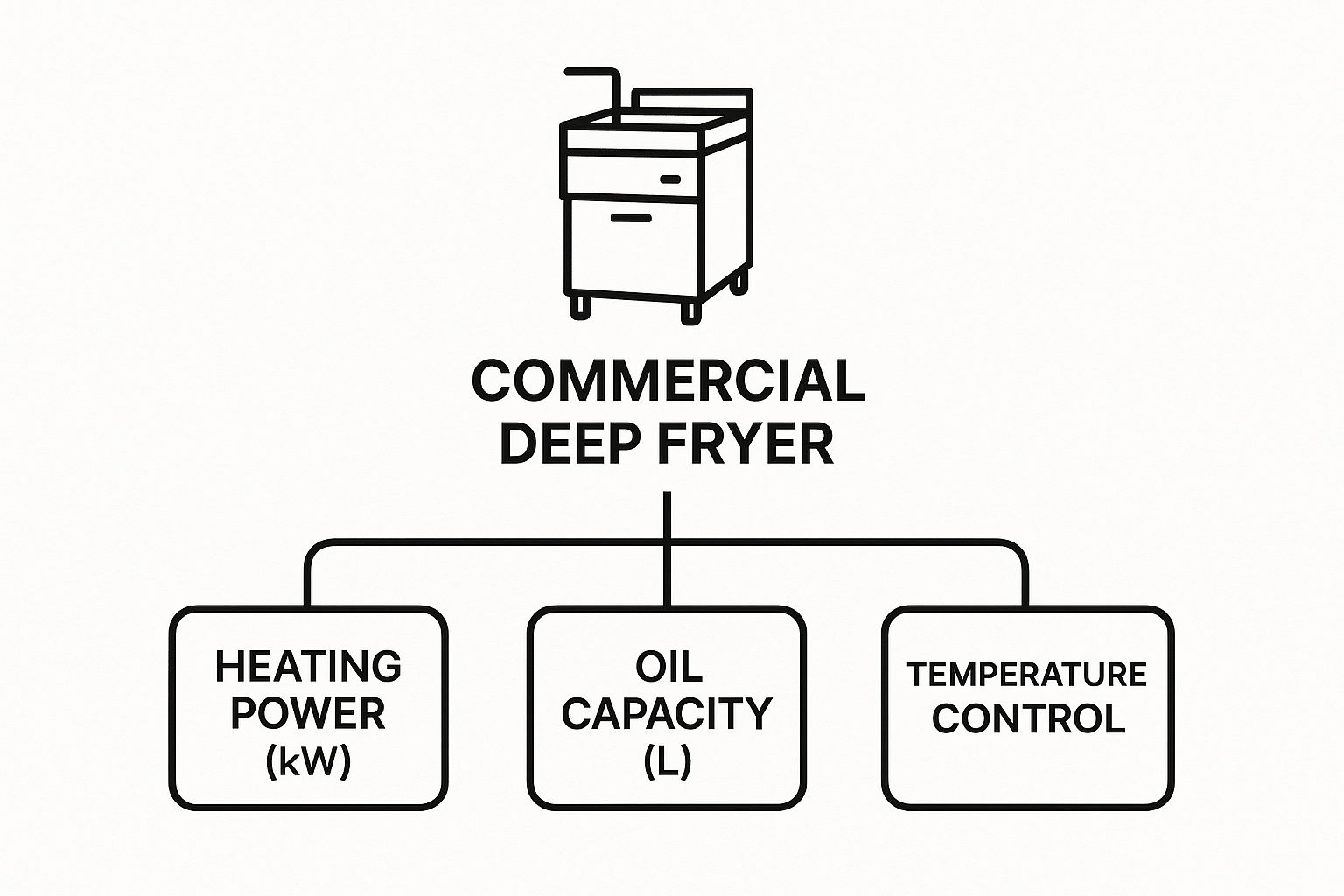
As you can see, these primary specs have a direct ripple effect on a fryer's performance and where it fits best in a commercial kitchen.
You’ll generally run into three main designs:
- Tube Fryers: These models have heating tubes that run right through the oil near the bottom of the tank. This clever design creates a "cold zone" underneath the tubes, where breading and other food particles can settle without getting scorched. This simple feature makes your oil last way longer, making tube fryers the perfect match for high-sediment foods like breaded chicken, fish, and onion rings.
- Open-Pot Fryers: Just like the name implies, these fryers have a wide-open pot with the heating elements on the outside. This makes them an absolute breeze to clean and maintain. They are the versatile workhorses of the kitchen, ideal for items that don't shed a lot of breading, like french fries, cheese sticks, and anything pre-battered.
- Flat-Bottom Fryers: This is a more specialized design. There’s no cold zone because the heat source is right under the pot's flat bottom. This setup provides gentle, even heat, which is exactly what you need for delicate, free-floating items you can’t cook in a basket—think donuts, funnel cakes, and perfectly light tempura.
Commercial Fryer Types at a Glance
To make sense of it all, here’s a quick comparison table to help you line up your menu with the right fryer type.
| Fryer Type | Primary Power Source | Best For (Menu Items) | Key Advantage | Main Consideration |
|---|---|---|---|---|
| Tube Fryer | Gas or Electric | Breaded Chicken, Fish, Onion Rings | Extends oil life with a sediment "cold zone" | Harder to clean around the internal tubes |
| Open-Pot Fryer | Gas or Electric | French Fries, Mozzarella Sticks | Extremely easy to clean and access | Not ideal for high-sediment foods |
| Flat-Bottom Fryer | Gas or Electric | Donuts, Funnel Cakes, Tempura | Gentle, even heating for delicate items | No cold zone, so oil quality needs monitoring |
This table should give you a solid starting point. Matching your fryer type to your top-selling items is one of the smartest equipment decisions you can make.
The demand for fried foods isn't slowing down, and the market reflects that. The global commercial deep fryer market is set to grow from around USD 583.92 million to over USD 798.24 million by 2032. This growth is driven by new tech, with some advanced fryers even using AI to get the perfect cook every time.
Choosing the right fryer is a big deal—it directly impacts your kitchen’s efficiency, food quality, and bottom line. Of course, a fryer is just one piece of the puzzle. For a wider view, check out this comprehensive guide to sourcing restaurant equipment. And if you're outfitting a new kitchen or just upgrading, leveraging our expert blog posting services for restaurant equipment supply websites can give you a great sense of what’s out there.
What to Look For: Features That Make or Break a Fryer
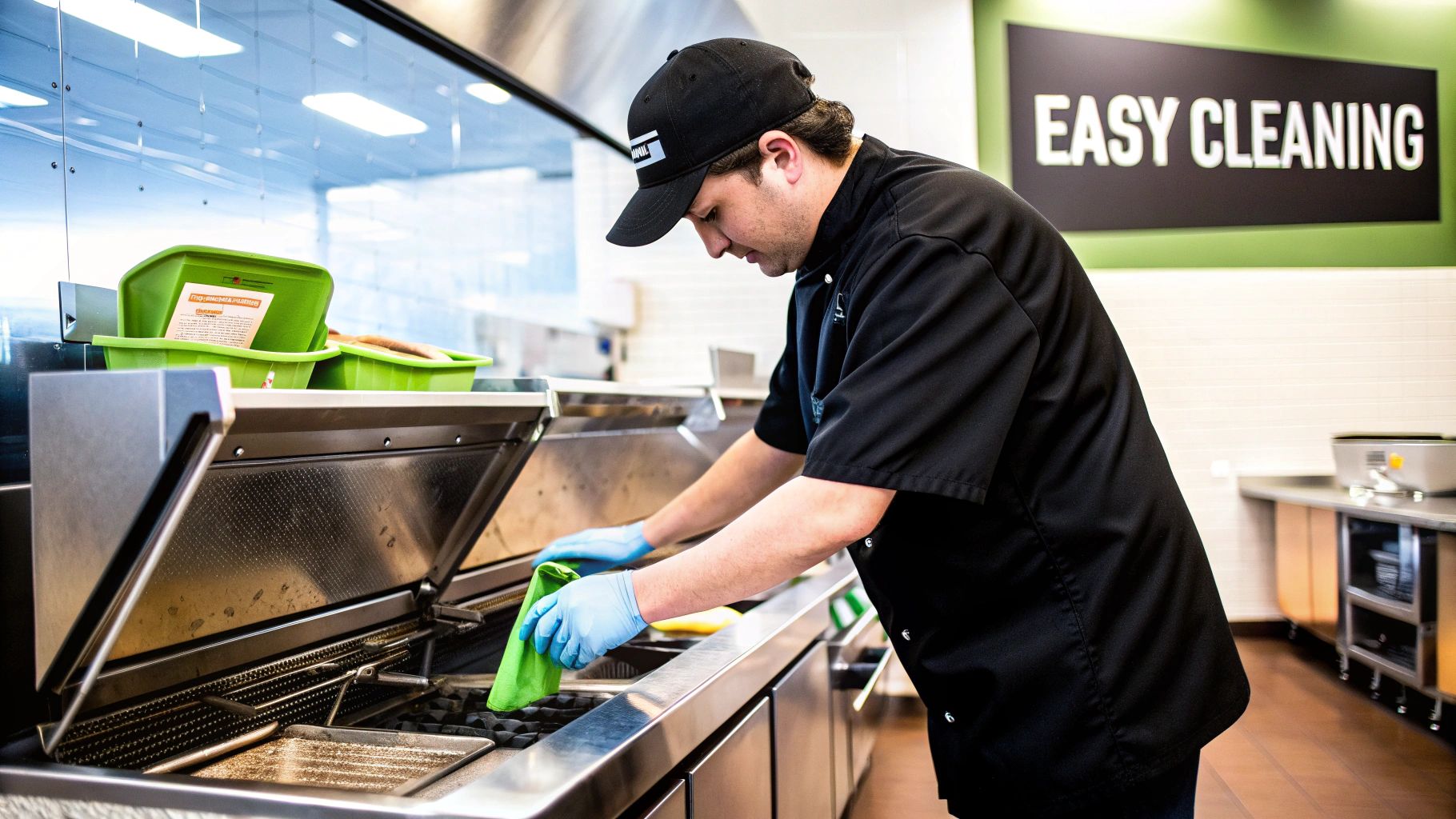
Once you’ve settled on the right type of fryer for your menu, the real magic is in the details. The specific features are what separate a decent commercial deep fryer from a truly great one, impacting its daily performance and how much it costs you in the long run. Think of this as your checklist for spotting the components that will actually pay you back.
The first thing you'll notice is the frypot’s capacity. This is more than just how much oil it can hold; it’s a balancing act between output and efficiency. A bigger pot lets you cook more food at once, but it also guzzles more oil and energy to stay hot.
A smaller pot is cheaper to run for a low-volume kitchen, but it'll create a serious bottleneck during a dinner rush. The goal is to match the pot size to your busiest hours. That way, you can keep up with orders without wasting money on an oversized unit that’s rarely full.
Recovery Time: The Secret to Crispy, Not Greasy
Ever wonder why food sometimes comes out soggy and oil-logged? The culprit is almost always a poor recovery time. This is a measure of how quickly the oil gets back up to the ideal cooking temperature after you drop in a basket of frozen fries or chicken.
Picture this: that cold food hits the hot oil, and the temperature instantly drops. A fryer with a fast recovery time kicks its burners or heating elements into high gear, bringing that temperature right back up. This sears the outside of the food, locking out excess oil and creating that perfect golden, crispy finish.
If the recovery time is slow, the food just sits there soaking in lukewarm oil, getting greasy. This single feature is probably the most important factor for consistent quality, especially when you're dropping baskets back-to-back during a busy service.
The Cold Zone: Making Your Cooking Oil Last Longer
One of the biggest recurring costs of running a fryer is the oil itself. That’s where a feature called a cold zone comes in to save the day. You'll usually find this in tube-style fryers. It’s simply an area at the bottom of the frypot, below the heating source.
Here’s how it works. As you cook, little bits of breading and food fall off into the oil. Without a cold zone, all that sediment settles onto the hot heating elements and burns. This scorching process breaks down the oil fast, creating nasty flavors and a dark color that transfers right onto your food.
The cold zone gives all that sediment a cooler place to land so it doesn't burn. By preventing this constant carbonization, a cold zone can dramatically extend the life of your cooking oil, potentially saving you hundreds or even thousands of dollars a year.
Game-Changing Automation
Beyond the basics, today’s fryers are packed with smart features that make life easier and your food more consistent. These innovations are a huge reason the global fast-food industry can operate so efficiently. The commercial deep fryer market was valued at around USD 583.92 million and is expected to keep growing, largely thanks to this tech. Things like automated basket lifts and digital controls are becoming standard because they cut down on labor and mistakes. To see how these trends are shaping the future, you can read more about the commercial deep fryer industry on Consegic Business Intelligence.
If you can spring for one feature, make it an integrated filtration system. This lets your crew drain, filter, and return the oil to the pot in just a few minutes, making a critical (and often dreaded) maintenance task both simple and safe.
Here are a couple of other high-impact features to keep an eye out for:
- Programmable Controls: These let you save specific cooking times and temperatures for everything on your menu. An employee just has to press a button for "Fries" or "Wings," and the fryer does the rest. Every single batch comes out perfect.
- Auto-Lift Baskets: This feature is a lifesaver. When the timer goes off, the fryer automatically lifts the baskets out of the oil. It makes overcooking impossible and frees up your cooks to focus on other things instead of babysitting a timer.
These aren't just bells and whistles. They turn a simple piece of equipment into a smart production machine that directly improves your food quality, lowers labor costs, and pads your bottom line.
How to Calculate Your Fryer's Total Cost of Ownership
When you’re buying a commercial deep fryer, it’s easy to get tunnel vision and focus only on the price tag. But that initial cost is just the down payment. To really understand what a fryer will cost your business, you need to look at its Total Cost of Ownership (TCO).
Thinking about TCO shifts your perspective from just buying a piece of equipment to making a strategic investment. It uncovers all the ongoing expenses—the ones that can quietly chip away at your profits—so you know the true lifetime cost of the machine before you buy.
The Four Pillars of Fryer TCO
Calculating the TCO isn't some complex accounting formula. It really just boils down to four key expenses you’ll face over the fryer's life. Getting a handle on these numbers upfront helps you see why a cheaper model can often be the most expensive one in the long run.
Here are the four pillars to consider:
- Initial Purchase and Installation: This one’s the most obvious—it’s the price of the fryer itself, plus any costs for a professional to hook it up, which is pretty much a given for gas models.
- Daily Energy Consumption: Whether you go with gas or electric, that fryer is going to be one of the hungriest appliances in your kitchen. High-efficiency models can trim this expense by a surprising 10-15%.
- Ongoing Maintenance and Repairs: Just like any workhorse in your kitchen, your fryer will need some TLC to keep it running right. Sooner or later, you'll have repair bills, too.
- Cooking Oil Costs: This is the big one. In fact, it's your single largest ongoing expense. A standard 50-lb fryer can hold over $50 worth of oil, and how often you’re forced to change it has a direct line to your profitability.
Why a Higher Price Can Mean a Lower Cost
It feels backward, but shelling out more cash upfront for a high-efficiency fryer with a good filtration system almost always leads to a lower TCO. Let's walk through a simple, real-world example to see how the math plays out.
Imagine you're choosing between two fryers:
- Fryer A (Standard Model): This one costs $1,500. It’s a basic open-pot design with no bells or whistles.
- Fryer B (High-Efficiency Model): This one will set you back $3,500. It has a built-in filtration system and an insulated frypot that holds heat much better.
At first glance, Fryer A looks like a no-brainer. But here's where it gets interesting. Fryer B’s filtration system can easily double the life of your cooking oil. If you’re spending $400 a month on oil with Fryer A, you might only spend $200 with Fryer B. That’s a savings of $2,400 a year, just on oil.
Total Cost of Ownership forces you to think like an investor, not just a buyer. The goal isn't to find the cheapest machine today, but the one that generates the most savings over the next five years.
On top of that, Fryer B's high-efficiency design could save you another $30-$50 per month on your utility bill. Over a five-year lifespan, the savings on oil and energy completely wipe out that initial $2,000 price difference and then some. This numbers-first approach lets you calculate your return on investment and pick a commercial deep fryer that will actually strengthen your restaurant's bottom line for years to come.
Mastering Fryer Maintenance and Safety
A commercial deep fryer is an investment that powers your menu. But protecting that investment takes more than a quick wipe-down at the end of the night. Proper maintenance is a non-negotiable routine that directly impacts food quality, extends the life of your equipment, and—most importantly—keeps your kitchen staff safe. If you let these tasks slide, you're signing up for faster oil breakdown, inconsistent food, and serious fire risks.
This isn't just a suggestion; it's a universal standard. The global deep fryer market is exploding thanks to the rise of quick-service restaurants and cloud kitchens, with over 300,000 fast-food outlets worldwide. Since over 90% of these places rely on deep fryers, mastering maintenance is essential for anyone doing high-volume cooking.
Your Daily Maintenance Checklist
Consistency is everything when it comes to fryer longevity. These simple, quick tasks should be part of your daily rhythm to stop minor issues from turning into major headaches.
- Skim Debris Frequently: Throughout the day, grab a fine-mesh skimmer and fish out any floating food particles. This simple step prevents those bits from carbonizing, which ruins your oil and makes everything taste a little off.
- Wipe Down Exterior Surfaces: At the end of each shift, wipe down the fryer's exterior—backsplash, sides, and all—with a clean, damp cloth and a mild degreaser. It stops that sticky, unsanitary grease film from building up.
- Check and Calibrate Temperature: Don't just trust the dial. Use an external thermometer to make sure your fryer’s thermostat is accurate. An off-kilter thermostat can lead to undercooked or burnt food and is a huge safety hazard.
Weekly and Monthly Deep Cleaning Routines
Daily upkeep is crucial, but you need to go deeper to tackle the stubborn buildup. This is where you really protect your oil quality and the internal components of your fryer.
A weekly boil-out is one of the most effective ways to deep-clean your fryer. The process is straightforward: drain the old oil, fill the frypot with water and a special cleaning solution, and bring it to a gentle boil. The solution gets in there and dissolves the hardened carbon and grease that simple scrubbing can't touch.
A regular boil-out does more than just clean; it resets your fryer. By eliminating carbon buildup on heating elements, you improve heat transfer, which means faster recovery times and lower energy consumption.
Your monthly routine should be a bit more of an in-depth inspection:
- Inspect Electrical and Gas Connections: Look over all cords, plugs, and gas lines for any signs of wear, fraying, or other damage.
- Clean Ventilation Hoods and Filters: Grease buildup in your ventilation system is a massive fire risk. Make sure those filters are cleaned thoroughly, following the manufacturer's guidelines to a T.
- Check Safety Features: Test the high-temperature limit shutoff to ensure it’s working correctly. This is the feature that could save your kitchen from a disaster.
Prioritizing Kitchen Safety
Operating a commercial deep fryer always comes with risks, but a strict safety protocol can create a secure environment for everyone on your team.
Proper grease disposal and drain maintenance are absolutely vital. Clogged drains from improperly handled grease can cause nasty backups and create hazardous, slippery floors. To make sure your kitchen's infrastructure can support your fryer without issues, it's wise to consult expert commercial plumbing services.
Finally, a well-managed fire suppression system is your last line of defense. Make sure your kitchen's system is up to local fire codes and inspected regularly (usually twice a year). More importantly, ensure every staff member knows the location and proper use of Class K fire extinguishers—the only kind designed specifically for grease fires.
Your Top Commercial Fryer Questions Answered
Even with all the specs laid out, there are always a few nagging questions that pop up when you're about to invest in a new fryer. Let's tackle some of the most common ones I hear from kitchen managers and restaurant owners to clear up any last-minute uncertainties.
How Often Should I Change the Fryer Oil?
Honestly, this depends entirely on what you're frying and how much of it. If you're running a high-volume chicken joint with tons of breaded items, you'll probably need to filter the oil every single day and swap it out completely every 2-4 days. A quieter spot might get 5-7 days out of its oil.
Forget the calendar, though. Your oil will tell you when it’s done. If it gets dark, starts smoking at lower-than-normal temperatures, or gives off a funky, rancid smell, it’s time for a change. Pushing old oil is a recipe for bad-tasting food and a serious safety risk.
What Is the Difference Between Standard and High-Efficiency Fryers?
Think of it like this: a high-efficiency commercial deep fryer has a smarter design—better burners or heating elements—that gets more heat into the oil with less wasted energy. They do cost more upfront, but they can trim your monthly gas or electric bill by 10-15%.
Standard fryers are the cheaper date initially, but they cost you more in the long run with higher utility bills. For almost any busy kitchen, the long-term savings on energy and oil consumption make a high-efficiency model a much smarter investment over its lifetime.
The single most important safety feature on any fryer is the high-temperature limit shutoff. This device automatically kills the power or gas if the oil gets dangerously hot, stopping it from hitting its flashpoint and starting a catastrophic fire. Make sure it's working during every maintenance check. No excuses.
Can I Fry Different Foods in the Same Oil?
You can, but you really, really shouldn't. The big problem here is something called "flavor transfer." Potent flavors, especially from proteins like fish, will seep into the cooking oil and make everything you fry after it taste… well, fishy. Nobody wants fish-flavored french fries.
The best practice is to have dedicated fryers for different food types. Keep one fryer for proteins like chicken and fish, and use another for things like fries, mozzarella sticks, and onion rings. This separation is crucial for maintaining food quality. Figuring out your kitchen's specific needs can get pretty detailed, and our article writing services for restaurant equipment supply websites can create content that dives deep into these topics. This simple step ensures every dish you send out tastes exactly the way it should.
At Charbroilers.com, we understand that the right equipment is the backbone of a successful kitchen. Our selection of high-quality charbroilers is designed to deliver the performance and reliability you need to create unforgettable dishes. Explore our collection today!