
Choosing a Commercial Countertop Food Warmer
Let’s be honest, serving lukewarm food is a one-way ticket to unhappy customers and shrinking profits. That’s where a commercial countertop food warmer comes in. Think of it as your kitchen's silent partner, the unsung hero that guarantees the last plate served is just as hot and delicious as the first.
Why a Food Warmer Is Your Secret Weapon
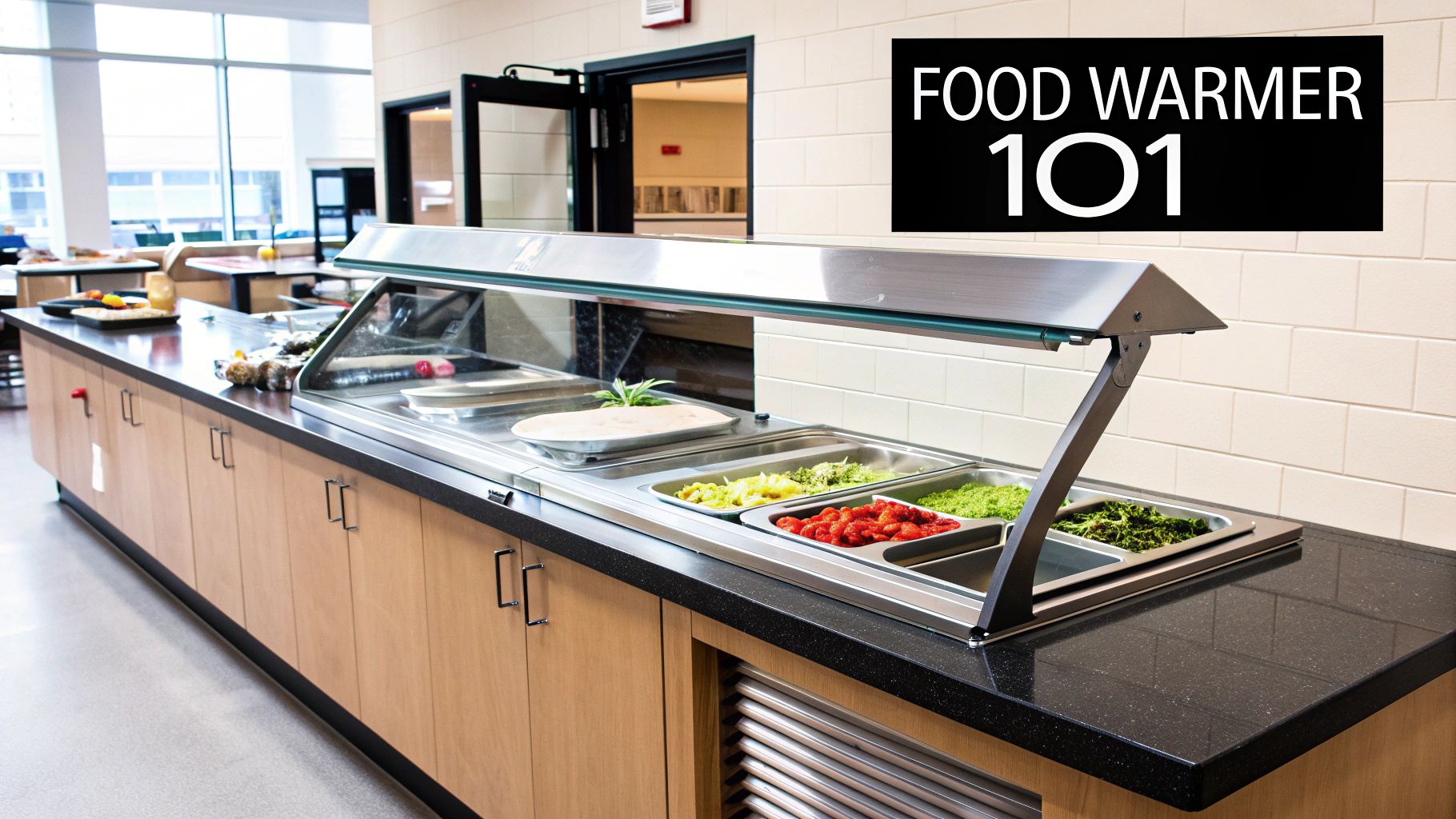
In any kitchen, consistency is king. From the chaos of the dinner rush to the slower pace of off-peak hours, keeping food at the perfect temperature is a constant battle. A commercial countertop food warmer isn't just another piece of equipment; it's a critical tool that tackles this challenge head-on.
This one appliance solves several massive headaches for restaurant owners and managers. It allows chefs to prep dishes ahead of time without sacrificing an ounce of quality, completely streamlining the kitchen workflow. This boost in efficiency means quicker service, which leads directly to happier guests and better table turnover.
The Impact on Your Bottom Line
Beyond keeping customers happy, a food warmer has a real, tangible financial benefit. By holding food at precise temperatures, it drastically cuts down on shrinkage and prevents the quality drop-off that leads to food waste. We're not talking about a minor tweak here—this is a serious operational advantage that directly protects your profit margins.
The industry is taking notice, too. The global market for these warmers has exploded, with a reported size between $1.5 billion and $1.86 billion. Projections show this isn't slowing down, with the market expected to hit $2.8 billion by 2033.
More Than Just Heat
At the end of the day, a commercial countertop food warmer is a reliable solution to some of the biggest problems in the foodservice industry. Investing in the right one for your operation can:
- Boost Customer Satisfaction: Hot, fresh food keeps people coming back for more.
- Slash Food Waste: Holding food properly means less product ends up in the trash.
- Improve Kitchen Workflow: Prepare for the rush with confidence, knowing your food is ready to go.
A quality food warmer is a workflow game-changer. It holds food exactly how you want, freeing your team to focus on cooking and serving without scrambling to reheat.
As we dive deeper, this guide will give you the know-how to pick the perfect unit. And for those looking to build their online presence, a well-researched restaurant equipment blog post can be a powerful tool for growth: We provide information on SEO, local citation services, blog posting, blogger outreach, copyrighting, and article writing for restaurant equipment supply websites.
How Different Food Warmers Keep Food Hot
Ever wondered how a food warmer keeps your french fries perfectly crispy but your mashed potatoes moist and creamy? The secret isn't just "heat." It's about using the right kind of heat for the job. Getting a handle on these different heating methods is the key to mastering your commercial countertop food warmer.
Not all heat works the same way. The science behind how your warmer operates has a direct impact on your food's texture, moisture, and quality. Think about it like cooking—you wouldn't use a broiler to bake a delicate cake. In the same way, you need the right type of warming technology to hold specific menu items perfectly.
Once you understand the basic principles of heat transfer, you can look past the marketing jargon on a spec sheet. That technical document becomes a practical tool, helping you pick a unit that will treat your food exactly the way it deserves.
Conduction: The Direct Heat Method
Conduction is the most straightforward way to heat something. It works through direct contact, pushing thermal energy from a hot surface right into a food pan. It's the same thing that happens when you set a skillet on a hot stove burner.
Picture placing a metal pan of mac and cheese onto a heated shelf inside a warmer. The heat travels directly from that shelf, through the pan, and into the food. It's an incredibly effective and efficient method, especially for foods held in pans where there’s a lot of surface area touching the heat source.
Steam tables are a classic example of conduction in action, with hot water directly warming the bottom of the food pans.
- Best For: Foods in metal pans like casseroles, sauces, and chilis where bottom-up heat is ideal.
- How It Works: Direct physical touch between the heat source and the food container.
- Analogy: Putting your hand on a warm mug to soak up its heat.
This direct approach is powerful, but you have to manage it. Without any moisture, it can sometimes dry out the bottom layer of food if it's held for too long.
Radiant Heat: The Targeted Sunshine
Radiant heat uses infrared waves to send energy straight to the surface of the food, just like how the sun warms your face on a bright day. It doesn't waste time heating the air in between. This "targeted sunshine" is the perfect solution for keeping certain foods at their best.
Heat lamps are the most common example here. They are fantastic at keeping fried foods like chicken tenders, onion rings, and fries crispy. Because they heat the food's surface without creating steam or humidity, they prevent that dreaded sogginess that ruins fried items. A commercial countertop food warmer with radiant elements provides that direct, crisping heat no other method can touch.
Radiant heat is a total game-changer for any menu with fried foods. It maintains that "fresh from the fryer" texture by hitting the food's surface directly, stopping moisture from turning your product limp and sad.
Convection Heat: A Warm, Circulating Hug
Convection heating is all about moving hot air around the food. Think of it as a gentle, warm hug that surrounds your dishes from every angle. A fan inside the warmer cabinet pushes the heated air around, creating a super-consistent temperature and getting rid of any annoying hot or cold spots.
This method is incredibly versatile and is the go-to for keeping moisture locked into a huge variety of foods. Since the heat is indirect and spread out so evenly, it’s much less likely to dry out or overcook anything. That makes it a wonderful choice for holding everything from roasted meats and vegetables to delicate pastries and stews.
A commercial countertop food warmer using convection gives you peace of mind that every item, whether it's on the top or bottom shelf, is held at the same exact temperature. That consistency is non-negotiable for food safety and quality, especially when you're in the middle of a busy service and need to trust your equipment completely.
Decoding the Must-Have Features
Choosing the right commercial countertop food warmer is like picking the right tool for a critical job. Get it right, and your kitchen runs smoothly. Get it wrong, and you're fighting an uphill battle. This is your checklist for looking past the shiny stainless steel and focusing on what really matters for quality, safety, and efficiency day in and day out.
A smart investment starts here. We're going to break down the essential features that separate a true kitchen workhorse from a machine that just creates headaches. From holding temperature perfectly to standing up to the chaos of a busy service, these are the non-negotiables.
The Foundation of Performance: Temperature and Humidity Control
The number one job of a food warmer is simple: hold food at a precise, safe, and consistent temperature. If it can't do that, nothing else matters. You're risking both food quality and, more importantly, customer safety. Your first big decision comes down to the controls.
- Manual Dials: These are the straightforward, no-fuss controls you'll often see on more basic models. They're great for general holding tasks where you just need to keep things "hot." But for anything delicate or temperature-sensitive, that lack of pinpoint accuracy can be a problem.
- Digital Thermostats: When you absolutely need precision, digital controls are the only way to go. They let you lock in an exact temperature—sometimes down to a single degree—and hold it steady. This is crucial for delicate sauces, perfectly cooked proteins, or anything that can quickly dry out or overcook.
Beyond just heat, humidity control is the secret weapon for keeping food tasting like it just came off the line. Think of it as creating a perfect little microclimate inside your warmer. For anything moist like mashed potatoes, steamed veggies, or braised meats, a unit with humidity control is a game-changer. It stops them from drying into a sad, unappealing state after hours of holding.
A warmer without humidity control is like trying to keep a plant alive in the desert. For any food that isn't meant to be crispy, managing moisture is just as important as managing heat.
Built to Last: Construction and Materials
Let's be honest, a commercial kitchen is a battlefield. Your equipment has to be tough enough to survive the daily grind. The way a warmer is built directly impacts how long it will last, how well it performs, and how easy it is to clean.
Stainless steel is the undisputed champion of kitchen equipment for a reason. It's tough, doesn't rust or corrode easily, and because it's non-porous, it’s a breeze to clean and sanitize. Sure, it might cost a bit more upfront, but a solid stainless steel unit is an investment that will pay you back by shrugging off dents, scratches, and constant use.
You might see some lighter-duty models made from aluminum. While it's lightweight and a decent heat conductor, it’s also much softer and more likely to get dented and scratched up. It can work for less intense situations or maybe a mobile catering gig, but for a busy restaurant line, stainless steel is almost always the smarter choice.
The infographic below gives you a great visual on how different models stack up when you weigh energy use against temperature range and capacity.
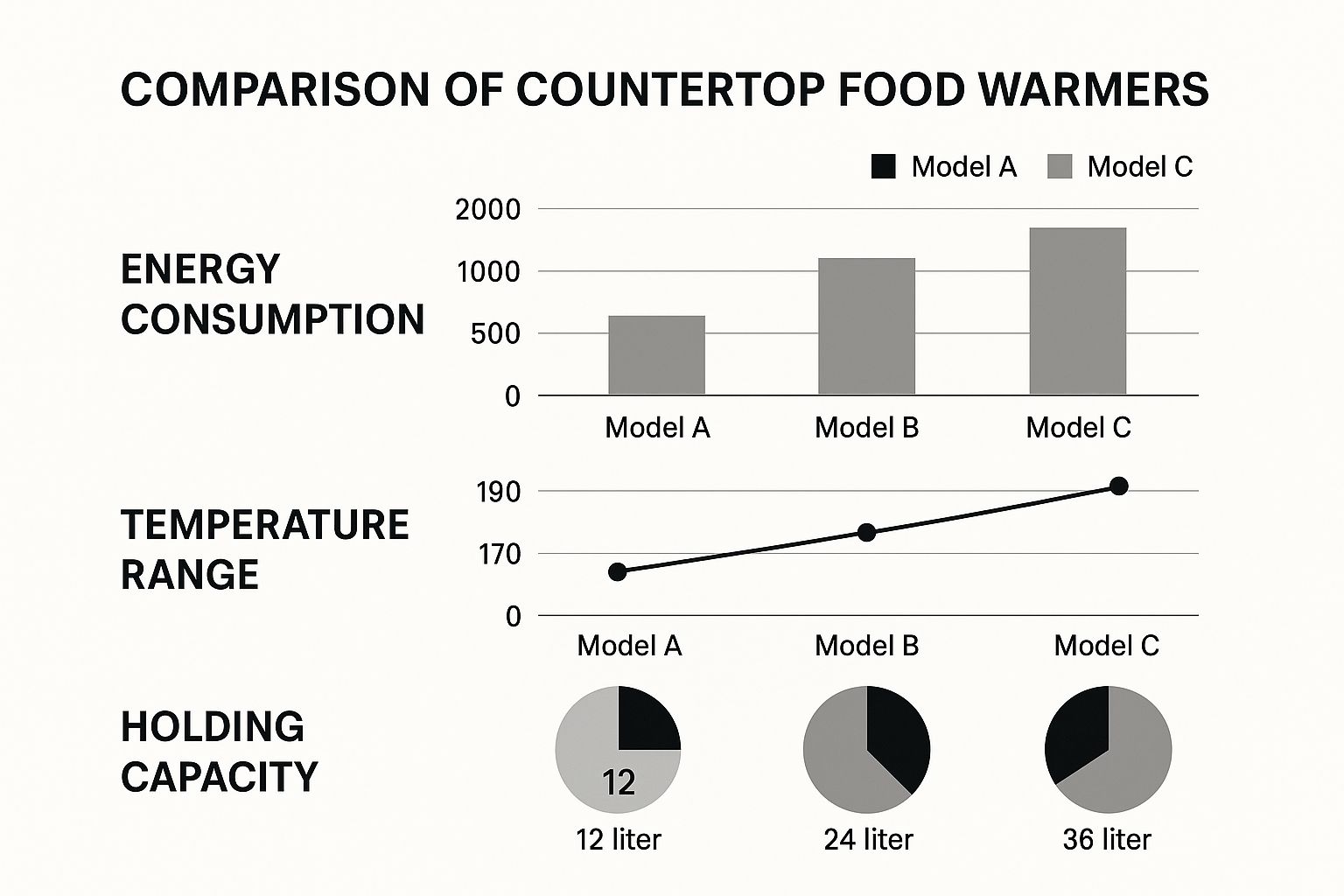
As you can see, the units that can hold more food and offer a wider temperature range often pull more power. It's a classic trade-off you'll need to consider for your specific kitchen.
Not all heating methods are created equal. The technology inside your warmer dictates how it heats the food, which can have a huge impact on food quality.
Comparing Countertop Food Warmer Heating Technologies
The way a warmer generates heat is a critical factor. Some methods are gentle and moist, while others are intense and dry. Choosing the right one depends entirely on what you plan to put inside it.
| Heating Technology | How It Works | Best For | Pros | Cons |
|---|---|---|---|---|
| Conduction (Steam Table) | A water pan is heated, and the steam rises to gently warm the food pans sitting above it. | Soups, sauces, gravies, mashed potatoes, and items needing moist heat. | Even, gentle heating; prevents food from drying out. | Requires water, slower to heat up, needs regular cleaning to prevent scale. |
| Convection | A fan circulates hot air around the food, creating an even temperature throughout the cabinet. | Fried foods, baked goods, roasted meats—anything that needs to stay crisp. | Fast heat-up, even temperature distribution, keeps food crispy. | Can dry out moist foods if there's no humidity control. |
| Radiant Heat | Elements (like Calrod) or heat lamps directly radiate heat onto the food from above or below. | Carving stations, holding finished plates, keeping fried items crispy for a short time. | Provides direct, intense heat; great for presentation. | Can create hot spots; may dry out or overcook food if left too long. |
| Induction | An electromagnetic field directly heats compatible metal pans, with no flame or hot element. | Buffets, catering, or any application where precise, efficient, and flameless heat is needed. | Extremely energy-efficient, precise temperature control, safe (surface stays cool). | Requires induction-ready pans; higher initial cost. |
Understanding these differences is key. You wouldn't use a dry, radiant heat lamp to hold a delicate sauce, just like you wouldn't use a steam table for french fries. Matching the tech to your menu is a recipe for success.
Features Tailored to Your Business
Finally, the best warmer is the one that fits your operation like a glove. A high-volume buffet line and a small café have completely different needs. Think about these practical, application-specific features:
- Sneeze Guards: If customers are serving themselves, this is non-negotiable for food safety and hygiene.
- Display Lighting and Glass Doors: Absolutely essential for merchandising in grab-and-go spots. You want customers to see how delicious the food looks.
- Pan Configuration: Can the unit hold standard full-size, half-size, or third-size pans? Having flexible configurations lets you hold different menu items at the same time without wasting space.
These are the details that smooth out your daily workflow. The demand from customers for quick, convenient food has pushed restaurants to find warmers that don't just keep food hot, but keep it good. At the same time, everyone is looking for more energy-efficient models and smart tech that can integrate with the rest of the kitchen. You can read more about these developing market trends to get more insights before you buy.
Matching the Warmer to Your Business
Choosing a commercial countertop food warmer isn't a simple off-the-shelf purchase. The perfect unit for a jam-packed sports arena would be a terrible fit for a high-end restaurant’s kitchen line. Nailing this decision is the final, crucial step in making a smart investment—one that pays you back every single day in efficiency and happy customers.
The key is to think about your daily grind. What are you serving? Who are you serving it to? And what kind of chaos—or precision—is your kitchen known for? Let's walk through a few real-world scenarios so you can picture exactly how the right food warmer becomes an indispensable part of your workflow, not just another appliance taking up space.
For the Fast-Paced Concession Stand or Kiosk
In a high-traffic spot like a concession stand, it’s all about speed, visibility, and durability. Your customers are in a hurry, and you need equipment that can keep up with the rush while tempting them to buy more. The ideal warmer here is a compact, high-visibility display model.
Think about the features that are built for this job:
- Glass Doors and Bright Lighting: These are non-negotiable. They’re your silent salesperson, showing off perfectly held pretzels, nachos, or hot dogs and driving those crucial impulse buys.
- Simple Controls: When the line is ten people deep, your staff doesn’t have time for complicated digital menus. Simple, sturdy manual dials are often far more practical and less likely to break down.
- Compact Footprint: Counter space is prime real estate. A small unit that makes the most of vertical space is a must.
For this kind of business, a radiant heat or dry convection warmer usually hits the sweet spot. These are fantastic at keeping fried or baked goods like fries and pretzels from turning soggy, so you always deliver that fresh-from-the-oven texture.
For the Precision-Focused Restaurant Kitchen
Behind the scenes in a fine-dining kitchen, the priorities do a complete 180. It’s not about flashy displays; it’s about holding delicate food components at exact temperatures without ruining their texture or quality. A chef has to trust their equipment to hold a sensitive sauce or a perfectly cooked protein without it drying out or overcooking.
This is where drawer warmers become the unsung heroes of the professional kitchen.
A countertop drawer warmer lets a chef hold different parts of a dish separately at their ideal temperature and humidity. This means a delicate fish fillet, a velvety sauce, and roasted vegetables can all be held in perfect condition, ready to be plated in an instant.
When you're looking for a commercial countertop food warmer for a kitchen line, seek out models with individual humidity and temperature controls for each drawer. This is the kind of precision that separates a good dish from a great one. And make sure it’s built like a tank with heavy-duty stainless steel to survive the heat and constant action.
For the Mobile and Adaptable Catering Operation
Catering is a different beast entirely. Your equipment needs to be a road warrior—durable, portable, and reliable enough to work flawlessly no matter where the event takes you. A delicate glass display warmer simply won't survive the trip.
For caterers, the focus has to be on portability and tough-as-nails construction.
- Portability: Look for units with sturdy handles, secure latches, and a weight you can actually manage. Some countertop models are designed specifically to be moved around a lot.
- Durability: A heavy-gauge stainless steel body is essential to handle the bumps and bruises of being on the road.
- Power Flexibility: Having a unit that performs consistently on different electrical circuits is a massive advantage when you're working in unfamiliar venues.
Caterers often get the most out of insulated holding cabinets that can maintain safe temperatures for hours, even when unplugged. Convection models are also a great pick because their even heat circulation keeps food quality high, no matter where it's being served. If you're building a new mobile kitchen or catering service, checking out the full range of specialized Los Angeles restaurant equipment can give you ideas for solutions built for the road.
The market for these warmers reflects just how different everyone's needs are. In North America, there's a huge trend toward adopting countertop warmers and buying them online. Meanwhile, the Asia Pacific region is seeing a massive surge in mobile warmers, all thanks to the booming food delivery business. The entire commercial food warmer market, valued at a whopping $2.5 billion, is expected to nearly double to $4.8 billion by 2032. This just goes to show how essential this equipment has become for the entire hospitality industry, from corner kiosks to global chains.
Extending the Life of Your Food Warmer
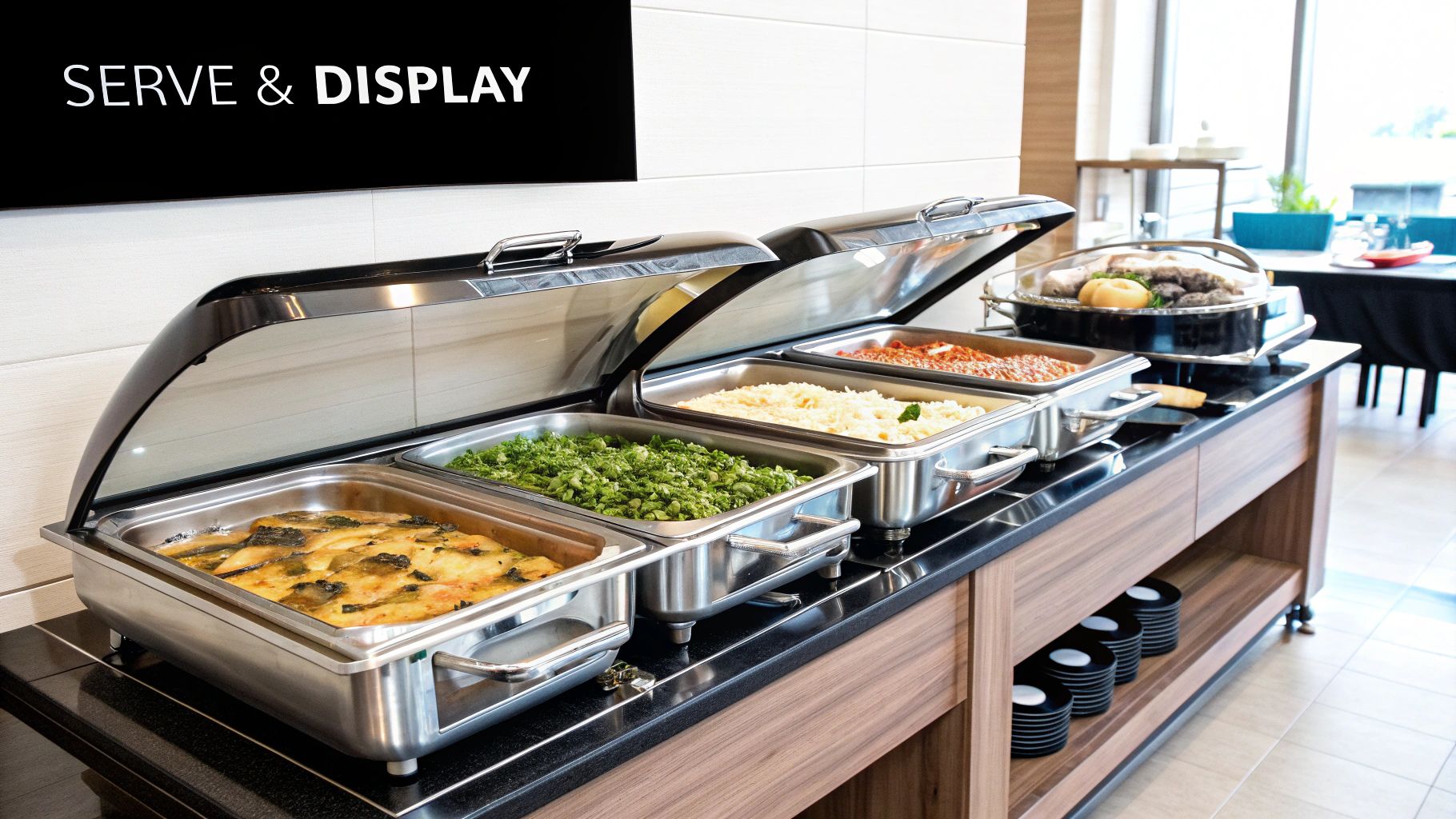
A quality commercial countertop food warmer is a serious piece of kit and a real investment in your kitchen's flow and your customers' happiness. Like any workhorse in your lineup, it needs proper care to keep performing day in and day out. Think of maintenance not as a chore, but as a smart move to protect that investment and dodge the headache of unexpected downtime.
Honestly, neglecting basic upkeep is the fastest way to kill your unit. Spills, scale from hard water, and bits of food don't just look messy; they can worm their way into the controls, mess with thermostats, and eat away at the heating elements. A little proactive care goes a long, long way in getting the most out of your warmer for years to come.
Best Practices for Daily Operation
How you use your warmer every single day has a massive impact on its lifespan and, even more critically, on food safety. Just a few simple rules of thumb will make sure every plate you send out is held perfectly, from the first ticket of the day to the last.
First up, always preheat your warmer. Tossing cold pans of hot food into a cold box forces the unit to work overtime, stressing the components and guzzling electricity. Give it at least 20-30 minutes to get up to a stable, safe holding temperature. This ensures your food never even thinks about dipping into the danger zone (anything below 135°F).
Next, think about how you're loading it. Jamming pans in there with no room to breathe is a recipe for disaster. It blocks airflow, creating hot and cold spots that wreck food quality and compromise safety. Always leave some space between pans so the heat can circulate evenly. That simple step turns your warmer into the reliable holding partner it's meant to be.
"Most equipment breakdowns we see stem from two things: improper cleaning and inconsistent operation. A simple, daily routine is the single most effective way to prevent costly repairs and ensure your warmer performs reliably day in and day out."
A Simple and Effective Maintenance Schedule
A solid cleaning schedule is your best defense against your equipment giving up the ghost too soon. When you break down the tasks into daily, weekly, and monthly jobs, keeping your warmer in top shape feels easy and doesn't bury your staff. It’s all about tackling the small stuff before it snowballs into a major repair bill.
These small, consistent actions stop grease and mineral deposits from baking on, which are a nightmare to scrub off later. Sticking to a schedule like this won't just make your equipment last longer; it also means you're always ready for a health inspection.
Preventative Maintenance Checklist
Here’s a straightforward checklist to keep your food warmer humming along. The best way to make this happen is to build these tasks right into your kitchen's closing routine so nothing ever gets missed.
| Frequency | Task Description | Key Benefit |
|---|---|---|
| Daily | Wipe down all exterior and interior surfaces with a soft cloth and mild, non-abrasive detergent. Clean glass doors and wipe up any food spills immediately. | Prevents grease and food debris from hardening or seeping into electrical components, which is a leading cause of thermostat failure. |
| Weekly | Perform a deeper clean. Remove and wash all removable parts like shelves and pan supports. If you have a steam unit, descale the water reservoir to prevent mineral buildup. | Stops hard water scale from damaging the water vessel and heating elements, ensuring efficient operation and preventing corrosion. |
| Monthly | Inspect door gaskets and seals for any signs of wear, cracks, or brittleness. Check that all controls, lights, and fans are functioning correctly. | A tight seal is crucial for heat retention and energy efficiency. Catching a worn gasket early prevents heat loss and saves on utility costs. |
Following a simple plan like this keeps small issues from becoming big, expensive ones.
Quick Troubleshooting for Common Issues
Even with the best care, you might run into a hiccup now and then. Knowing how to spot and solve the simple stuff can save you the cost and hassle of a service call.
- Temperature Fluctuations: If the temp is all over the place, first check that the door is closing tight and the gasket isn't torn. Also, make sure the unit isn't overcrowded or sitting in a drafty spot.
- Unit Not Heating: Before you pick up the phone, make sure it's plugged into a working outlet and the circuit breaker hasn't tripped. Sometimes it’s just a bad power cord.
- Water Leaking (Steam Models): Leaks are usually from a cracked water pan or a bad drain valve. You can often spot these early during your weekly clean.
Stick with these operating tips and the maintenance schedule, and your commercial countertop food warmer will be a reliable, efficient MVP in your kitchen for years.
Frequently Asked Questions
When you're looking at a new piece of kitchen equipment, a few last-minute questions always pop up. It's totally normal. Getting those final details ironed out is what helps you buy with confidence and get the most out of your new warmer from day one.
We've heard just about every question in the book, so we've pulled together the most common ones right here. Think of this as the last checklist item before you find the perfect unit.
Answering Your Top Questions
Getting the facts straight makes the decision-making process a whole lot easier. Here are the answers to three of the most critical questions we get about countertop food warmers.
-
Can I cook food from raw in a commercial countertop food warmer?
Absolutely not. This is probably the single most important thing to know. These units are built for one job and one job only: holding already cooked food at a safe temperature. They simply don't have the power to cook raw food safely and should never be used that way. -
What is the ideal temperature for holding hot food?
Food safety regulations are crystal clear here. Any hot food must be held at 135°F (57°C) or higher to keep dangerous bacteria from growing. You should always set your warmer to maintain at least this temperature—no exceptions. -
Should I use a food warmer with or without water?
This really comes down to what you're serving and the type of warmer you have. A steam table model needs water to create that gentle, moist heat—perfect for keeping mashed potatoes, gravies, or sauces from drying out. On the other hand, dry warmers are your go-to for anything crispy, like french fries or fried chicken, that would turn soggy in a moist environment.
The biggest takeaway for any new owner is understanding the difference between holding and cooking. A food warmer is your best friend for maintaining quality and safety after the food is cooked; it's never a replacement for your oven, grill, or fryer.
If you need more specific advice on picking the right equipment for your menu, don't hesitate to reach out to our team of experts for some one-on-one guidance.
Ready to elevate your menu with perfectly held food? Explore the top-tier selection of charbroilers and holding equipment at Charbroilers.com and find the ideal solution for your kitchen today. Visit us at https://charbroilers.com.