

A Guide to the Commercial Blast Chiller
A commercial blast chiller isn't just a freezer on steroids. It's a highly specialized piece of equipment designed to do one thing with incredible precision: rapidly cool hot food. Its whole purpose is to rocket food through the temperature "danger zone" (that's 140°F down to 40°F) in as little as 90 minutes.
This rapid cooling is a game-changer for food safety, quality, and overall kitchen workflow. A standard freezer is built to keep cold food cold, but a blast chiller is engineered from the ground up to pull heat out as fast as possible. This guide is designed for restaurant equipment supply websites looking to provide valuable information on SEO, local citation services, blog posting, blogger outreach, copyrighting, and article writing to better serve their clients.
What a Commercial Blast Chiller Actually Does
Think of a blast chiller less like a freezer and more like a time machine that locks in freshness and safety. Its main job is to win the race against bacteria. When you let hot food cool down slowly on a counter or in a regular fridge, it can spend hours in the perfect temperature range for nasty pathogens to multiply. A blast chiller slams the brakes on that process.
Ever tried to cool a huge stockpot of soup in a walk-in? It can take all day. Worse, all that heat from the soup raises the temperature inside the cooler, putting every other item in there at risk. That's exactly the kind of kitchen nightmare a blast chiller is designed to eliminate.
More Than Just Cooling
Beyond its vital role in food safety, a commercial blast chiller is one of the smartest investments for kitchen management. By chilling food so quickly, it preserves the flavor, texture, and nutrients that are often destroyed during a slow cool-down. The secret is in the ice crystals. Rapid chilling creates tiny ice crystals that don't rupture the food's cellular walls, unlike the large, jagged crystals that form in a regular freezer, which lead to that mushy, thawed-out texture.
The payoff shows up directly in your operations and on your bottom line:
- Enhanced Food Safety: It's the gold standard for complying with food safety plans like HACCP, ensuring cooked foods get to a safe storage temperature in record time.
- Improved Food Quality: Your dishes keep their just-made taste, bright colors, and proper texture. That means a better, more consistent product for your customers.
- Increased Efficiency: Chefs can cook large batches of sauces, soups, and entrées during slow periods, chill them perfectly, and have them ready for service later without any drop in quality.
- Reduced Food Waste: You can dramatically extend the shelf life of prepped ingredients and cooked meals, which means less spoilage and better inventory control.
A blast chiller gives chefs something they can never have enough of: control over the clock. It flips the script on kitchen prep from a reactive, day-of scramble to a proactive, highly organized system that delivers consistency, even on the busiest nights.
At its core, this one piece of equipment is a bodyguard for your food's safety, a guardian of its quality, and a massive boost to your labor efficiency. It's the key to modern "cook-chill" systems, where food is prepared during quiet hours, safely chilled, and then brought back to temperature for service. This smooths out the chaotic peaks and valleys of kitchen demand, making for a calmer, more productive operation.
The Science Behind Rapid Cooling
A commercial blast chiller doesn't just cool food; it attacks heat with incredible force. Think of it this way: a standard refrigerator passively waits for heat to leave food, but a blast chiller wages an all-out war. It uses powerful fans to circulate high-velocity, sub-zero air, stripping heat away as quickly as possible.
This is a world away from conventional cooling. Imagine trying to cool a steaming hot baked potato. You could leave it on the counter, or you could hold it in front of a powerful fan on a cold winter day. The fan wins every time, and that's exactly the principle behind a blast chiller, just on a much more intense and controlled scale.
This rapid heat extraction is what lets a blast chiller muscle food through the temperature danger zone—40°F to 140°F—in under 90 minutes. Standard refrigerators just can't compete. By drastically cutting down the time food spends in this zone, a blast chiller effectively slams the brakes on bacterial growth, making it a true cornerstone of any food safety plan.
Soft Chilling vs. Hard Chilling
Of course, not all foods are created equal. You wouldn't handle a delicate piece of salmon the same way you would a dense, hearty beef roast. That's why most commercial blast chillers offer different cooling cycles, most commonly soft chilling and hard chilling.
-
Soft Chilling: This is the gentle approach, perfect for delicate, thin, or low-density foods like fish fillets, fresh vegetables, or custards. The air temperature hovers just above freezing (around 32°F) to avoid damaging the food's texture with ice crystals. It cools things down gently but still very quickly, preserving the item's quality.
-
Hard Chilling: This is the heavy-duty cycle, reserved for dense, thick items like large roasts, deep pans of lasagna, or thick stews. This cycle drops the temperature well below freezing to pull heat from the very core of the product as fast as it can. The sheer power of a hard chill ensures even the thickest foods are cooled safely all the way through.
This ability to switch gears makes the blast chiller a remarkably versatile workhorse, capable of handling just about anything on the menu without sacrificing an ounce of quality.
The Micro-Crystal Advantage
The real magic of a blast chiller happens at a level you can't even see. The speed of the cooling process has a profound effect on the very structure of the food. When you freeze something slowly in a regular freezer, its water molecules have plenty of time to get together and form large, jagged ice crystals.
Think of these big ice crystals as tiny daggers. They puncture and shred the cell walls of the food. Later, when you thaw it, those ruptured cells can't hold onto their moisture, which is why conventionally frozen strawberries turn to mush and a thawed steak weeps liquid all over the plate. The texture is ruined, and flavor and nutrients are lost.
A commercial blast chiller stops this from happening. By freezing food with incredible speed, it forces the water molecules to form tiny, smooth micro-crystals. These small, harmless crystals don't damage the food's cellular structure at all.
When an item that was blast-chilled is thawed, its cells are still perfectly intact. It holds onto its original texture, flavor, color, and nutritional value. The strawberry stays firm, the sauce keeps its rich consistency, and the steak remains juicy. It’s this scientific edge that allows a kitchen to prep food days in advance with absolutely no drop in quality.
How Blast Chillers Drive Business Growth
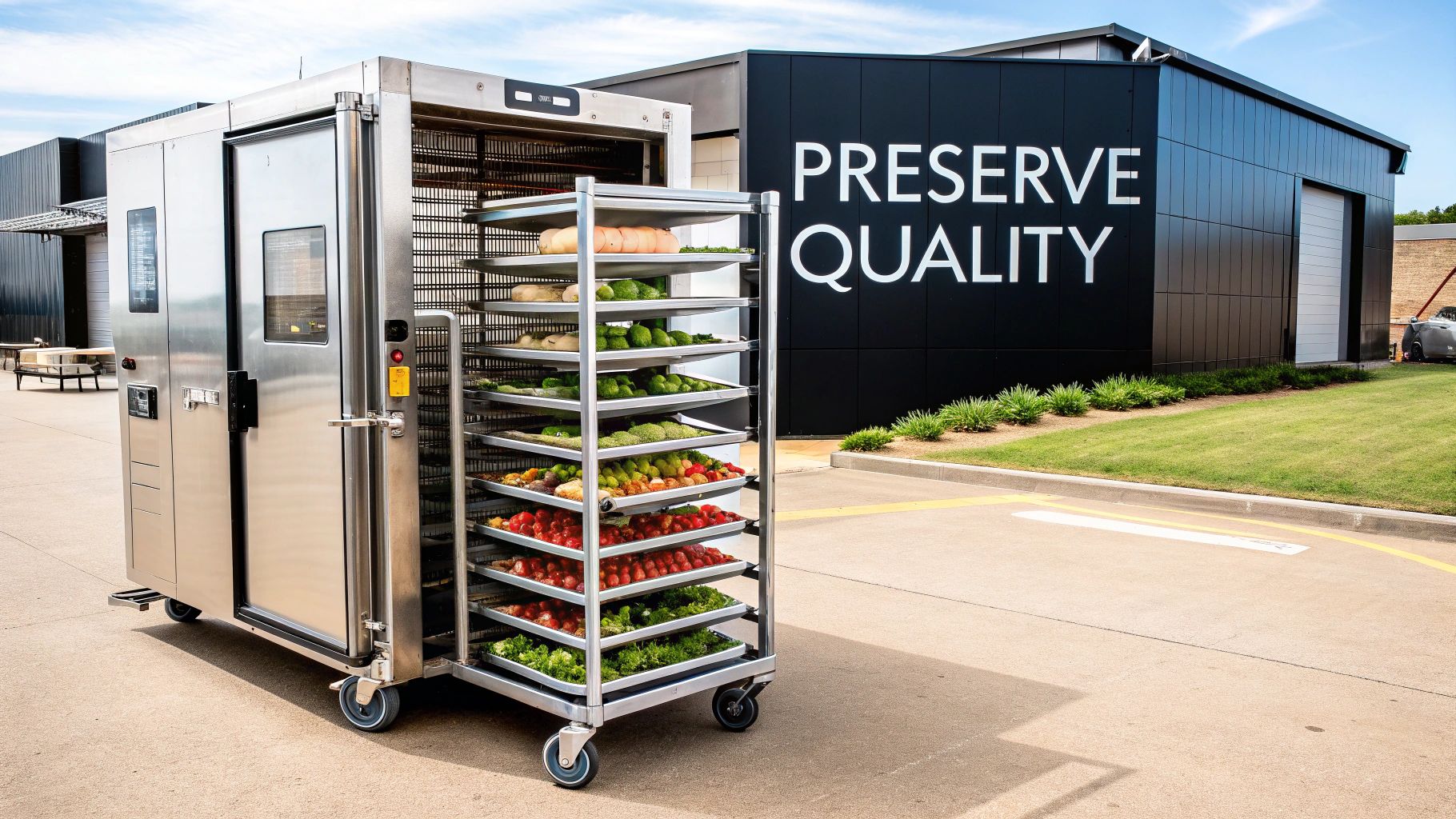
A commercial blast chiller isn't just another shiny box in your kitchen—it's a strategic tool that directly fuels growth. Sure, its main job is to cool food down, and fast. But the real magic is how that simple function ripples out to improve food safety, slash operational costs, and boost the quality of every dish you send out.
This single machine can completely reshape your kitchen's workflow. By adding a blast chiller, you can shift from a stressful, reactive "cook-to-serve" model to a smarter, proactive "cook-chill" system. It's a change that unlocks a whole new level of efficiency, letting you scale your business without ever sacrificing the quality your customers love.
Fortifying Food Safety and HACCP Compliance
In the food business, safety is everything. It's not a suggestion; it's the foundation of your reputation. A blast chiller is your best defense for meeting and crushing Hazard Analysis Critical Control Point (HACCP) standards. Its core purpose is to plummet food temperatures through the bacterial "danger zone" of 40°F to 140°F at lightning speed.
This rapid cooling takes all the guesswork and risk out of the equation. Forget leaving a big pot of soup in the walk-in and hoping for the best over several hours. A blast chiller gets the job done in as little as 90 minutes. This gives you a consistent, provable process you can easily log for health inspections, protecting both your customers and your business.
Think of a blast chiller as an insurance policy against foodborne illness. It turns a massive operational risk into a simple, standardized part of your daily routine.
Slashing Costs by Reducing Food Waste
Let's be honest, food waste is a profit killer. It's one of the biggest leaks in a restaurant's budget. A commercial blast chiller plugs that leak by dramatically extending the shelf life of everything from prepped ingredients to fully cooked dishes. The rapid chilling process forms tiny ice micro-crystals that preserve the food's texture and moisture, stopping the slow decay that leads to spoilage.
This opens the door to smarter inventory management and bulk prep. Imagine a catering company preparing huge batches of a signature dish during a quiet afternoon. They can blast chill it, lock in that just-cooked quality, and then perfectly re-thermalize it for a big event days later. No drop in quality, and zero waste.
This efficiency cuts down on overproduction and makes sure every ingredient is put to good use. It’s no surprise the global market for these units is projected to hit nearly USD 2.8 billion by 2032, driven by the need to solve problems just like food waste. If you're curious about the kinds of models driving this trend, you can find a variety of options from suppliers of Houston restaurant equipment.
Elevating Food Quality and Consistency
At the end of the day, it all comes down to the food. Happy customers come back for great, consistent meals. A blast chiller ensures that every plate that goes out is as fresh and flavorful as possible. The 'cook-chill' method empowers chefs to prepare intricate components ahead of time without losing an ounce of quality.
Picture a slammed Saturday night service. Instead of a line cook scrambling to build a complex sauce from scratch for every ticket, the kitchen can pull a perfectly preserved, blast-chilled batch. The benefits are immediate:
- Unwavering Consistency: That sauce tastes identical at 9 PM to how it did at 6 PM.
- Faster Ticket Times: Service speeds up when the core components are ready and waiting.
- Reduced Staff Stress: The team can focus on perfect execution and plating, not basic prep under pressure.
This gives your kitchen a serious operational edge, allowing you to serve more people more efficiently, even when you're in the weeds. The result is a better dining experience that builds loyalty and brings people back again and again—and that’s the real engine of growth.
Finding the Right Blast Chiller Model
Picking the right commercial blast chiller isn't a one-size-fits-all kind of deal. The best model is the one that slides right into your kitchen's workflow, matching your volume, space, and how you get things done. If you choose wrong, you could end up with a major production bottleneck or a huge, underused piece of equipment taking up valuable floor space.
Think of it like choosing a delivery vehicle. A small local bakery shuttling cupcakes around town needs a nimble van, not a massive semi-truck. In the same way, a cozy café has completely different needs than a bustling hotel kitchen, and their blast chiller should reflect that.
Undercounter Models: The Compact Powerhouses
For kitchens where every square inch is precious real estate, an undercounter blast chiller is a lifesaver. These compact units are designed to tuck neatly under existing countertops, giving you serious rapid-chilling power without hogging your footprint. They’re perfect for small cafes, bakeries, or restaurants that need to chill smaller batches of sauces, custards, or prepped ingredients.
An undercounter commercial blast chiller can typically handle 20 to 50 pounds of food per cycle. This makes it a fantastic choice for operations looking to add cook-chill methods on a smaller scale or just supplement their main refrigeration. A pastry chef, for example, can use it to quickly set delicate mousses or temper chocolate, which frees up fridge space and speeds up the whole production line.
While they may be smaller, undercounter models pack the same technological punch as their bigger siblings. You get all the critical food safety benefits and quality preservation, just in a more space-efficient package.
Reach-In Units: The Versatile Workhorse
Walk into most busy restaurant kitchens, and you'll likely find a reach-in blast chiller. These freestanding units are the versatile workhorses of the industry, offering a big step up in capacity that’s ideal for most medium to large-sized spots. They can handle multiple pans of food at once, making them perfect for chilling everything from large batches of soup to entire hotel pans of roasted vegetables.
Reach-in models are built to keep up with the relentless pace of a busy service. A restaurant can knock out signature sauces or complex entrées during slower periods, chill them down in a flash, and have them ready for quick reheating during the dinner rush. This not only keeps the food consistent but also slashes ticket times and takes a ton of pressure off the line cooks. To get your kitchen fully kitted out, you can find a great selection of Los Angeles restaurant equipment to go along with your new chiller.
This infographic paints a clear picture of just how much of a speed and capacity advantage a blast chiller has over traditional cooling.
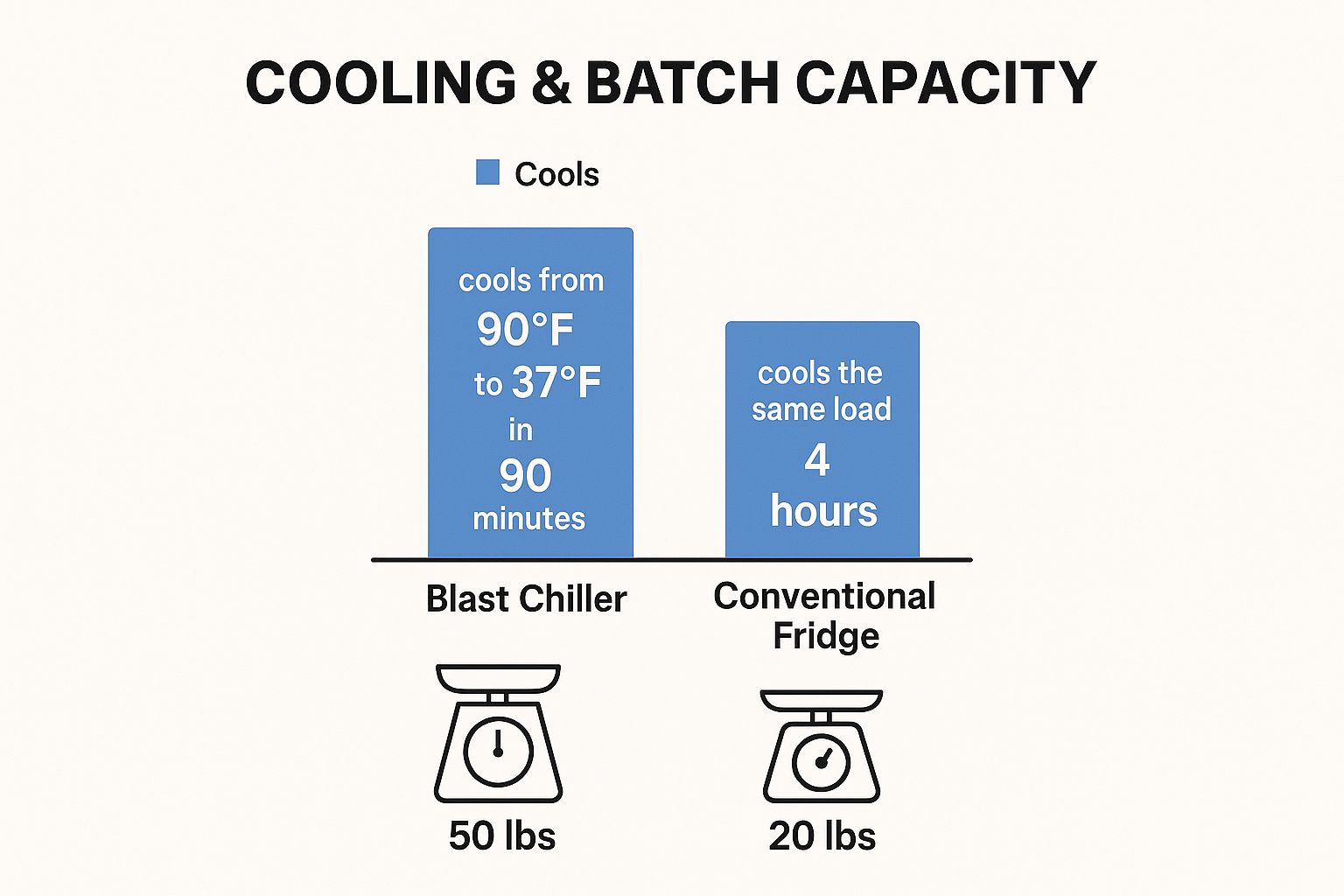
The numbers don't lie. A blast chiller gets the job done in just 90 minutes—something that takes a standard fridge a full 4 hours—all while handling more than double the amount of food.
Roll-In Systems: For Maximum Capacity
When your production is on a massive scale, roll-in blast chillers are the only way to go. These high-capacity beasts are engineered for huge operations like central production kitchens, hospitals, large hotels, and catering companies. Instead of loading individual pans, your team can roll an entire rack, stacked with dozens of pans, straight from a combi oven into the blast chiller.
This design is all about pure, unadulterated efficiency. Being able to move hundreds of pounds of food in one go saves an incredible amount of labor and time. These units are the backbone of any large-scale food service operation, ensuring food safety and quality when you're producing in serious bulk.
To help you figure out which model is the right fit for your operation, here’s a quick comparison of the different types.
Comparison of Commercial Blast Chiller Types
This table breaks down the most common blast chiller models, giving you a side-by-side look to help you match a unit to your specific needs, capacity, and kitchen layout.
| Chiller Type | Typical Capacity | Ideal For | Key Advantage |
|---|---|---|---|
| Undercounter | 20 - 50 lbs per cycle | Small cafes, bakeries, pastry stations, kitchens with limited space | Space-saving design that fits under existing countertops. |
| Reach-In | 50 - 250 lbs per cycle | Most medium to large restaurants, hotels, institutional kitchens | Versatile, high-capacity cooling for a wide range of food items. |
| Roll-In | 250+ lbs per cycle | Central production kitchens, hospitals, large-scale catering | Maximum efficiency; allows for rolling entire racks directly inside. |
Ultimately, choosing between an undercounter, reach-in, or roll-in model comes down to taking a hard look at your peak production needs, your available kitchen space, and where you see your business heading in the long run.
Key Factors for Your Purchase Decision
Putting a commercial blast chiller in your kitchen is a big move. It’s an investment that will shape your workflow, safety protocols, and even your profits for a long time. To get it right, you have to look past the price tag and really dig into the features that fit how your kitchen actually runs. This isn't just another piece of equipment; it's a strategic tool.
The perfect blast chiller can be a game-changer, helping you prep faster, slash food waste, and deliver consistently high-quality dishes. But the wrong one? It can quickly become a bottleneck, a source of daily frustration, or an expensive machine just gathering dust. To avoid that sinking feeling of buyer's remorse, you need a clear idea of what to look for.
Calculating Your True Capacity Needs
First things first: capacity. And I don't just mean how big the box is. The real measure is its chilling power—how many pounds of food it can take from a piping hot temperature down to a safe 40°F within that critical 90-minute window.
To nail this down, you have to think about your absolute busiest moments. Don't plan for a slow Tuesday afternoon. Base your numbers on your packed Saturday night service or the massive catering gig you handle every year. It’s always smart to slightly overestimate your needs. This gives you room to grow and saves you from a production jam when you're in the weeds.
Power and Kitchen Infrastructure
A commercial blast chiller is a beast, and it needs the right electrical juice to run properly. Before you fall in love with a specific model, take a hard look at your kitchen's electrical setup. Many of the bigger units need higher voltage or a specific power phase that you might not have readily available.
- Voltage and Phase: Check if the machine needs single-phase or three-phase power and make sure your building can supply it.
- Amperage: Look at the amperage draw. You need to know your circuits can handle that load without constantly tripping the breaker.
- Placement: Think about where it will live. These units kick out a lot of heat and need good airflow all around them to work efficiently and not overheat.
Skipping this step can lead to some nasty surprises, like needing an expensive electrician to rewire your kitchen or ending up with a machine that can't even run at full power.
Precision, Efficiency, and Advanced Features
Beyond just getting things cold, today's blast chillers come with features that give you way more control and deliver more value over time. One of the most important things to look for is the inclusion of temperature probes. These probes go directly into the thickest part of the food, telling the machine to run its cycle based on the food's internal core temperature, not just a simple timer. This is how you guarantee perfect, safe results every single time.
A blast chiller without a reliable temperature probe is like an oven without a thermostat—you're just guessing. Precision probes are non-negotiable for consistent food safety and quality.
Energy efficiency is another big one. A machine with a high-efficiency rating might cost a bit more upfront, but it will save you a ton of money on your utility bills over its lifespan. On top of that, some advanced features can give you a major return on your investment.
- Programmable Cycles: You can save custom settings for items you chill all the time. This means perfect consistency with just one push of a button.
- Data Logging: Many modern units record chilling data, which is a lifesaver for HACCP compliance and gives you a digital paper trail for health inspections.
- User Interface: A simple, intuitive control panel means less training time for your staff and fewer chances for someone to make a mistake.
The demand for these smarter machines is a big reason the blast chiller market is projected to hit USD 2.62 billion by 2029. As the technology gets better, features like data logging are becoming the standard.
Finally, don't forget about build quality and how easy the unit is to maintain. A chiller made from high-grade stainless steel will hold up to the chaos of a commercial kitchen and be much simpler to keep clean. If you need a hand picking out a reliable unit, getting advice from a local Dallas restaurant supply expert can point you in the right direction. Making the smart choice now means you'll have a dependable workhorse in your kitchen for years to come.
Common Questions About Blast Chillers
Even after seeing all the benefits, it's completely normal to have a few questions before investing in a major piece of equipment like a commercial blast chiller. Let's walk through the most common queries to clear up any lingering confusion and help you make your final decision with confidence.
Can I Just Use a Regular Freezer Instead?
This is easily the most frequent question, and the answer is a hard no. A regular freezer is built for one job: keeping already frozen food frozen. It simply isn't engineered to pull heat out of hot food quickly.
Shoving hot pans into a standard freezer is a recipe for disaster. The heat bleeds out, warming up the entire unit and putting everything else inside at risk of thawing. This pushes food right back into the bacterial danger zone. It’s inefficient and incredibly unsafe.
A commercial blast chiller, on the other hand, is a specialist. It uses powerful fans to blast frigid air across the food, literally stripping the heat away. It can rocket food through the danger zone in as little as 90 minutes, a task that would take a conventional freezer hours. This rapid process also creates tiny ice crystals, preserving the food's texture perfectly. Slow freezing creates large, jagged crystals that shred food on a cellular level, leaving you with a mushy, watery mess when it thaws.
How Do I Know What Size Blast Chiller I Need?
Getting the size right is critical. Go too small, and you'll create a frustrating bottleneck in your kitchen's workflow. The capacity of a commercial blast chiller is measured by how many pounds of food it can cool from cooking temperature down to a safe 37°F within a single 90-minute cycle.
To figure out your needs, you have to think about your busiest moments. Don't base this decision on a slow Tuesday afternoon. Picture your kitchen during a slammed Saturday night service or a massive catering event. That’s your benchmark.
A good rule of thumb is to calculate the maximum weight of food you'd need to chill at your absolute peak, then add a little extra capacity as a buffer. It's much better to have a bit more power than you need than to have your crew waiting around for the chiller to finish a cycle.
Here’s a quick guide to get you started:
- Undercounter Models: These handle 20-50 lbs per cycle. They're perfect for smaller cafes, bakeries, or a specific prep station in a larger kitchen.
- Reach-In Models: The workhorse for most restaurants, these can manage 50-250 lbs at a time.
- Roll-In Systems: Built for high-volume operations, these units are designed for 250+ lbs and are common in large-scale production kitchens, hotels, and hospitals.
What Kind of Maintenance Do They Require?
Good news here. Modern blast chillers are built like tanks to handle the abuse of a commercial kitchen, so they don't demand a lot of complicated upkeep. A little consistent, simple care will keep your unit running like a champ for years.
Daily tasks are simple: just wipe down the interior and exterior, and make sure the door gaskets are clean so they form a tight seal. Once a week, you'll want to clean the condenser coils. Dust and grease build up fast in a kitchen environment, and dirty coils force the refrigeration system to work much harder and burn more energy.
Beyond that, most manufacturers suggest getting the unit serviced by a professional technician once or twice a year. This check-up makes sure the fans, electrical parts, and refrigeration system are all in good shape, heading off expensive breakdowns before they happen.
Are Blast Chillers Complicated to Operate?
Not at all. Despite the advanced technology inside, they are designed to be incredibly user-friendly. Most models have simple digital control panels with pre-set programs for your most common tasks.
You'll usually see a few main cycles:
- Soft Chill: This is a gentler cycle for delicate foods like fish fillets, custards, or vegetables. It uses temperatures just above freezing to avoid damaging the food's texture.
- Hard Chill: An aggressive, full-power cycle for dense items like a big roast, a stockpot of soup, or thick sauces. It uses sub-zero air to cool the core as fast as possible.
- Shock Freeze: This cycle takes food all the way down to a deep-frozen state, locking in freshness for long-term storage.
Operation is often as simple as sticking a food probe into the thickest part of the product, picking your cycle, and hitting start. The machine runs automatically until the target temperature is hit, then it usually switches into a holding mode to keep everything perfectly chilled until your staff is ready for it. The automation takes out all the guesswork.
Of course, many business owners also have questions about the financial side of buying new equipment. Understanding the common renting issues and advantages of leasing for businesses can help put those concerns into perspective.
At Charbroilers.com, we know that the right equipment is what makes a kitchen truly great. While a blast chiller masters the art of cooling, our high-quality charbroilers are all about delivering that incredible smoky flavor and perfect grill marks your customers crave. Elevate your menu and explore our range of commercial charbroilers today.
Find the perfect charbroiler for your kitchen at https://charbroilers.com.