

How to Build Local Citations for Restaurant Equipment Supply Websites
To successfully build local citations, you need to be meticulous. It's all about getting your company's correct Name, Address, and Phone number (NAP) listed consistently across every important online directory, B2B platform, and industry-specific website. Think of it as a network of digital signposts, all pointing to your showroom or office and telling search engines you're a real, legitimate business.
Why Local Citations Are a Supplier's Secret Ingredient
In the competitive world of restaurant equipment supply, visibility is everything. You could stock the best commercial charbroiler on the market, but if restaurant owners can't find you online, you're leaving money on the table. This is exactly where local citations come in. They are the digital version of word-of-mouth, building your business's online reputation one mention at a time.
Here's a simple way to look at it: every single time your company's name, address, and phone number (your NAP) shows up correctly on a site like Yelp, a B2B directory, or an industry blog, it's like a vote of confidence. These consistent mentions send a strong signal to Google that your business is legitimate, active, and a trusted part of the local foodservice industry.
Turning Digital Mentions into Real-World Customers
The payoff from a solid citation profile is real and you can see it in your bottom line. When a restaurant manager searches for "commercial kitchen supply near me" or "restaurant equipment downtown," Google’s algorithm zips through the web looking for the most relevant and prominent businesses to show. A dense web of accurate citations dramatically improves your odds of landing in the coveted "Local Pack"—that map and list of three businesses right at the top of the search results.
But this isn't just about playing nice with an algorithm. It's about earning the trust of potential B2B customers. When a buyer sees your supply company listed with the same details across multiple platforms they already use, it reinforces your credibility. On the flip side, messy information—like an old phone number or a misspelled street name—creates confusion and doubt. That hesitation is often all it takes to send a potential client straight to your competitor.
A strong citation profile does more than just boost rankings; it tells a story of reliability. Each consistent NAP listing is another proof point that your supply business is a stable, professional operation that customers can count on.
The Core Pillars of Citation Value
Local citations are a foundational piece of any local SEO strategy because of how directly they impact search rankings and customer trust. They are a huge factor in how Google assesses a business's prominence, proximity, and relevance—the three pillars of its local search algorithm.
This table breaks down how each part of a citation actually helps your supply business get found.
How Citation Components Boost SEO for Equipment Suppliers
| Component | Description | Why It Matters for Equipment Suppliers |
|---|---|---|
| Business Name | The official, legal name of your company. | Consistency is key. Using "City Restaurant Supply" on one site and "City Restaurant Supply LLC" on another confuses Google and customers. |
| Physical Address | The complete street address, including suite or unit number. | This is your location pin. It's critical for "near me" searches and getting B2B clients to your showroom. |
| Phone Number | Your primary, local business phone number. | Drives direct contact. This is how clients ask about inventory, check pricing, and place orders. |
| Website URL | A direct link to your company's homepage. | Connects the dots. It funnels traffic from directories directly to your product catalogs and contact forms. |
| Business Categories | The specific type of product or service you offer (e.g., Restaurant Equipment Supplier, Commercial Kitchen Design). | Relevance is everything. This helps you show up for specific searches like "commercial refrigeration" or "charbroiler supplier." |
Understanding these components shows that a citation is much more than just a simple listing. It's a structured piece of data that feeds directly into how search engines and customers perceive your business. Our expertise in local SEO and local citation services ensures that every element is optimized for restaurant equipment supply websites like yours.
Remember, citation-building is one critical part of a much bigger marketing picture. For a deeper dive into the whole landscape, this comprehensive guide to digital marketing for restaurants is a great resource. And to really nail the fundamentals, check out our detailed article explaining what is a local citation and why it's so important.
Ultimately, getting your citations right gives you control over your company's digital identity. It ensures that when a restaurant owner is ready to invest in new equipment, your business isn't just visible—it's presented as the reliable, professional choice. This is how you turn simple online data into real results: more calls, more quote requests, and most importantly, more clients.
Conducting Your Company's Digital Footprint Audit
Before you even think about building new local citations, you have to inspect your company's existing digital foundation. Kicking off with an audit of your online presence is the only way to uncover the small, damaging errors that quietly sabotage your local SEO.
Think of it like checking your warehouse inventory before placing a supply order—you need to know exactly what you have before you start adding more. This means systematically finding every single online mention of your business to hunt down inconsistencies that confuse both customers and search engines.
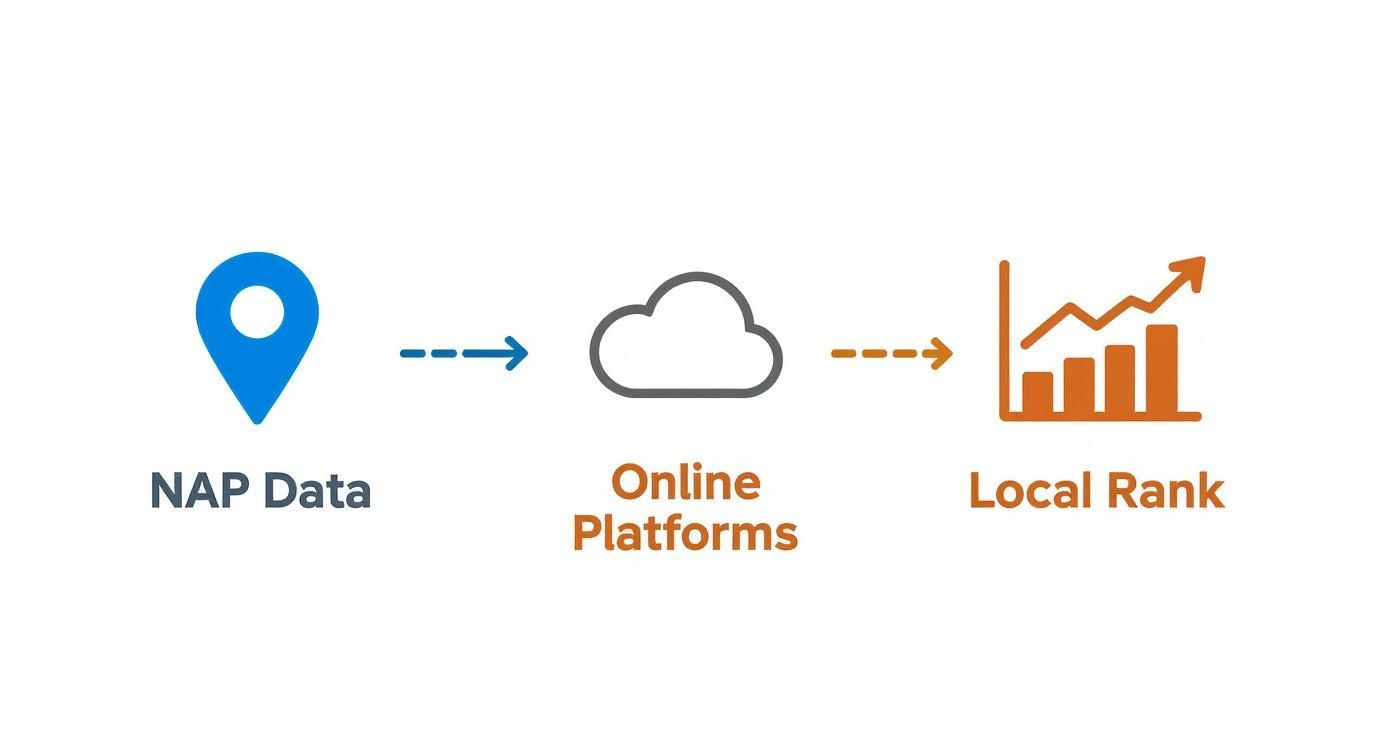
As you can see, getting your data straight from the get-go is what builds the authority you need to show up higher in local search results.
Starting Your Search for Inconsistencies
The best way to start is the old-fashioned way: manual searches. Just open up Google and start looking for your company's name in every variation you can think of. Don't just search your official business name; try common abbreviations, old names if you've rebranded, or even common misspellings.
The most common—and most harmful—issues you'll find are related to your Name, Address, and Phone number (NAP). An inconsistent NAP is a massive red flag for search engines.
Here are the critical inconsistencies you need to watch for:
- Name Variations: "Metro Equipment Supply" vs. "Metro Equipment Supply Inc."
- Address Formatting: "123 Commerce Street" vs. "123 Commerce St."
- Phone Number Issues: Old or disconnected numbers, or tracking numbers listed as the primary line.
- Duplicate Listings: Multiple profiles on the same directory, often created by previous owners, data aggregators, or well-meaning staff.
Each one of these little discrepancies creates a fracture in your digital identity, chipping away at the trust search engines have in your business information. This is why a thorough audit is so much more than a quick check-up. For a deeper technical dive, our complete guide explains how to perform a website audit for your company's main site.
Organizing Your Audit Findings
As you start uncovering these listings, you need a simple way to track everything. A basic spreadsheet is your best friend here. Create a sheet with columns to log every citation you find, whether it’s right, wrong, or a duplicate.
Your spreadsheet should have columns for:
- Directory/Website Name: The source of the citation (e.g., Yelp, ThomasNet).
- URL of Listing: A direct link to your business profile page.
- Status: Mark it as "Correct," "Incorrect," or "Duplicate."
- NAP Details Listed: Record the exact name, address, and phone number you see on the site.
- Notes: Add any useful details, like "Old phone number" or "Incorrect business hours."
This simple, organized approach turns a chaotic hunt into an actionable cleanup plan. It becomes your command center for tracking every fix and making sure nothing slips through the cracks.
Documenting every citation, good and bad, is the only way to gain full control over your company's online reputation. This spreadsheet isn't just a list; it's your battle plan for achieving perfect NAP consistency.
Using Free Tools to Deepen Your Audit
Manual searches are a great start, but free tools can help you dig up listings you might have missed. Your Google Business Profile (GBP) is your most important citation and the best place to begin.
Start by making sure your GBP information is 100% correct. Think of it as the "source of truth" that so many other directories pull from. Any errors here will almost certainly be duplicated across the web, creating a mess you'll have to clean up later.
Once your GBP is perfect, other tools and your manual searches will help you see where those inconsistencies have spread. By the time you finish this audit, you'll have a clear, prioritized list of every fix needed to build a powerful and consistent digital presence for your company.
You've done the audit, you know where you stand. Now it's time to get your hands dirty and start building your citations where they'll have the biggest impact.
Not all online directories are created equal. To get the most significant SEO boost and actually get restaurant owners in the door, you need to be strategic. The key is to prioritize the high-authority platforms that both Google and your customers already know and trust.
Think of these as the cornerstones of your company's digital presence. Get these foundational listings right, and you'll see the most immediate and substantial results for your time and effort. They're non-negotiable.
The Power Trio of Local Search
Before you even start thinking about niche trade publications or that new local business directory, you have to lock down your listings on the three platforms that power the vast majority of local searches and navigation apps. These are your absolute first-priority citations.
- Google Business Profile (GBP): This is so much more than a citation; it's your most powerful free marketing tool. Your GBP feeds the Google Local Pack and Google Maps, which is often a customer's very first interaction with your company.
- Apple Maps: As the default map app for millions of iPhone users, an accurate listing here is critical for getting B2B customers to your front door, literally.
- Bing Places for Business: It might not be Google, but Bing still holds a significant slice of the search traffic pie. Ignoring it is like leaving money on the table.
Perfecting your Google Business Profile is the most crucial first step, hands down. For a complete walkthrough, our guide shows you exactly how to get a Google Business listing set up correctly from the start. This single profile feeds data to dozens of other directories, so getting it right is a huge win.
Optimizing for the Restaurant Equipment Industry
Once your core map listings are claimed and polished, it's time to shift focus to where B2B buyers live online—the platforms where they actively search for, review, and compare equipment suppliers. These sites are essential for building the professional proof that convinces someone to give you a call.
For an equipment supplier, a generic listing just won't cut it. You need to fill out every single field with rich, compelling information that makes a potential customer confident in your inventory and service. This all starts with your primary citation source. Learn more about optimizing your Google My Business profile to squeeze every last drop of value out of it.
Platforms like Yelp, LinkedIn, and Facebook need a more tailored approach. Here’s what you need to do to make them work for your supply business:
- Choose Hyper-Specific Categories: Don't just list "Supplier." Get granular. Are you a 'Restaurant Equipment Supplier,' a 'Commercial Kitchen Installer,' or a 'Refrigeration Wholesaler'? The more specific you are, the better your odds of showing up in targeted searches.
- Upload High-Quality Product Photos: This is non-negotiable. Listings with professional photos of your showroom, warehouse, and featured products get way more engagement. Show off that top-of-the-line charbroiler!
- Link to Your Product Catalogs: Don't make people hunt for your inventory. Link directly to your online catalog or specific product category pages on your website.
- Actively Manage Reviews: You have to respond to reviews—both the good and the bad. A prompt response shows you're an engaged business owner who cares about the customer experience.
Think of these platforms as your digital storefront. A complete, photo-rich, and actively managed profile on a B2B directory can be just as important as the sign above your physical location.
Expanding Your Reach to Core Directories
Beyond the big names, there's a huge universe of directories that can boost your local search performance. In fact, for 2025, experts have identified over 65 top-tier citation sources that are essential for global local SEO campaigns.
The most powerful sources still include the ones we've covered—Google Business Profile, Apple Maps, and Bing—but also extend to Yelp, Facebook, LinkedIn, the Better Business Bureau, and even legacy directories like Yellow Pages.
By focusing your initial efforts on this curated list of foundational and industry-specific platforms, you're putting your energy where it will make the biggest difference. This structured approach builds a strong, consistent, and impactful citation profile that brings real-world results: more B2B buyers finding their way to your business.
With your foundational citations locked down, it's time to dig deeper and build some serious, targeted relevance. While the big directories cast a wide net, niche and hyperlocal citations send powerful signals to search engines about your business's specific focus and community roots. These are the listings that truly set you apart.
Think of it this way: a listing on Yelp tells Google you're a local business. A listing on a foodservice industry trade publication's website tells Google you're a serious player in the restaurant supply world. That's the kind of specific authority that helps you rank for high-intent searches from professionals who need equipment right now.
Diving into Industry-Specific Directories
Industry-specific directories are websites focused entirely on a particular business category. For restaurant equipment suppliers, these are absolute goldmines of relevance. Getting listed on these platforms tells search engines that you’re not just some business—you’re a serious player in the foodservice world.
These directories often carry more SEO weight than a generic listing because their audience is so dialed in. A mention here puts your company in front of people already looking to purchase equipment or find a new supplier. We specialize in identifying these opportunities through our blogger outreach and article writing services.
Here's where to start looking:
- B2B and Supplier Directories: Think ThomasNet, Global Sources, or other directories focused on industrial and commercial supply chains.
- Restaurant & Hospitality Associations: If you are a member of a national or state restaurant association, ensure your business is listed in their supplier directory.
- Foodservice Blogs & Trade Publications: A feature on a foodservice industry blog or a mention in an online trade magazine provides a powerful, trusted citation that feels more like an endorsement than a listing.
Deciding where to focus your energy can be tough. This table breaks down the unique value each type of targeted citation brings to the table for your company's SEO.
Finding the Right Citation Sources for Your Supply Company
| Citation Type | Description | Example for an Equipment Supplier | Primary SEO Benefit |
|---|---|---|---|
| Niche (Industry) | Platforms focused on a specific industry, attracting a highly relevant audience. | Listing your business in a national directory for commercial kitchen equipment wholesalers. | Relevance. Signals to Google your specific expertise (e.g., commercial refrigeration). |
| Hyperlocal (Location) | Websites centered on a specific city, neighborhood, or community. | Being featured on your local Chamber of Commerce or Business Improvement District website. | Prominence. Establishes your company as a trusted, active part of the local business community. |
As you can see, both types of citations are crucial, but they serve slightly different purposes in building a complete local SEO profile.
Uncovering Hyperlocal Opportunities
Hyperlocal citations are what anchor your business firmly within its neighborhood. These mentions from local organizations are incredibly valuable because they're tough for out-of-town competitors to get, creating a strong local moat around your business.
Start by thinking about your company's physical community. Are you part of a local business improvement district? A member of the local chamber of commerce? These groups almost always have member directories on their websites.
Getting your supply company listed on the local city business directory is more than just a citation; it's an endorsement. It tells both local restaurants and search engines that you are a recommended, integral part of the local B2B scene.
To track these down, fire up Google and run a few targeted searches:
- "[Your City] business association"
- "[Your County] business directory"
- "Sponsor [Local Food Festival Name]"
Don't forget that sponsoring a local culinary school event or a community festival often lands you a citation on their website. It's a win-win that builds goodwill and SEO value at the same time.
A Note on B2B Citation Building
For a business that supplies restaurant equipment, like commercial charbroilers, your strategy must include B2B directories that restaurant-only businesses will completely miss.
Look for listings on supplier directories, equipment financing websites, or foodservice industry portals. These B2B citations build a different kind of authority, signaling to search engines your role in the bigger foodservice supply chain. This strategy helps you capture a different, but equally valuable, professional audience. By pursuing both general local and B2B citations, you create a truly comprehensive and authoritative digital footprint.
Keeping Your Citations in Top Shape
If you want to truly master local citations, you have to accept one simple truth: this isn't a "set it and forget it" job. Getting your company listed online is just the start. The real, lasting value comes from keeping a close eye on those listings over time.
Think of your citation profile like your warehouse inventory. You wouldn't just stock it once and walk away for a year. It needs regular checks to make sure everything is fresh, accurate, and ready to go. This constant vigilance ensures that both B2B customers and search engines always find the right info about your business.
https://www.youtube.com/embed/e4P0crXiEow
Have a Process for Updates
Your business information isn't set in stone. You might change your hours, get a new phone number, or even move to a bigger, better location. Every time something like this happens, you need a simple, straightforward process to update your information everywhere, and fast.
Without a plan, it’s just too easy for old, outdated information to float around online, leading to frustrated customers and hurting your local SEO. The second a business detail changes, your first stop should always be your Google Business Profile. Update it immediately. It's the source of truth for so many other platforms.
After that, just work your way down the priority list of directories you built during your audit. That spreadsheet is now your go-to checklist for every platform that needs a refresh. It's a simple but structured approach that prevents the kind of NAP inconsistencies that can completely derail all your hard work.
Are Your Citations Actually Working?
So, how do you know if all this citation building is actually paying off? The goal isn't just to get listed; it's to see a real impact on your bottom line. By tracking the right numbers, you can turn this SEO task into a measurable driver of real growth for your company.
You can see the practical value of citations in how people behave. With around 70% of U.S. consumers using Google to check out local business reviews, you can't afford to be invisible. On top of that, businesses with complete Google Business Profiles—which are powered by accurate citations—are seen as 2.7 times more trustworthy than those with missing info. You can dig into more of these local SEO findings on digitalsilk.com.
Here’s what you need to be watching to measure your success:
- Local Search Rankings: Use a rank tracking tool to see where you stand for key local searches like "[your city] restaurant supply" or "commercial charbroilers near me." As your citation profile gets stronger, you should see a steady climb up the rankings.
- Referral Traffic in Google Analytics: Pop into your Google Analytics and head to the acquisition reports. Look at the "Referral" traffic source to see which directories are actually sending people to your website. A jump in traffic from a B2B directory is a crystal-clear sign your listings are doing their job.
- Google Business Profile Insights: This is where the magic happens. Your GBP dashboard gives you invaluable data on how customers are interacting with your listing right in the search results.
Watching your GBP Insights is like standing at your business's digital front door. It tells you exactly how many people asked for directions, picked up the phone to call you, or clicked through to your website.
Key Metrics to Watch in Your GBP Dashboard
Your Google Business Profile serves up a ton of data that directly connects your citation health to real-world customer actions. Keep a close watch on these metrics in particular:
- Phone Calls: An increase in calls coming from your GBP listing is a fantastic sign. It means potential clients are finding you and are ready to ask about inventory or place an order.
- Direction Requests: This is one of the most powerful metrics you have. Every request represents a potential customer who is actively trying to get to your physical location.
- Website Clicks: More clicks here show that your optimized listing is successfully funneling interested buyers to your online product catalogs and contact forms.
By checking these numbers regularly, you create a powerful feedback loop. You can see what’s working, prove the value of your local SEO efforts, and make smarter decisions to keep bringing more and more customers through your doors.
Got Questions About Citations? We've Got Answers.
Even with a solid plan, you're bound to run into a few tricky questions when you're building out local citations for your supply company. The finer details of local SEO can feel a little overwhelming at times, but trust me, most of these challenges have pretty simple solutions.
Think of this section as your go-to cheat sheet. We'll tackle the most common questions and roadblocks business owners face, clearing things up so you can get back to what really matters—growing your business.
How Long Until I See Results from Building Local Citations?
This is one area where patience really is a virtue. Results from building your citation profile don't happen overnight. You can generally expect to see a real, noticeable impact on your local search rankings within 2 to 6 months.
Of course, that timeline isn't set in stone. If your company is in a super competitive metro area, it might take a bit longer to climb the ladder. Likewise, if your initial audit turned up a huge mess of NAP inconsistencies, the cleanup time will naturally extend how quickly you see results.
On the bright side, changes you make on high-authority sites like your Google Business Profile can sometimes show results in just a few weeks. The real magic, though, comes from the cumulative effect over time, as search engines constantly crawl the web and find your consistent info everywhere.
Should I Build Citations Manually or Use a Paid Service?
Ah, the classic "time versus money" debate. The right answer here really depends on your specific situation.
If you're running a single-location supply company, building citations by hand gives you total control and is incredibly cost-effective—if you have the time to do it. A hands-on approach is fantastic for getting listed on those unique local business directories or niche industry portals that a big, automated service might overlook.
On the other hand, paid citation services are a lifesaver for saving time, scaling your efforts, or managing multiple locations. They can submit your business data to dozens, sometimes hundreds, of directories all at once. Our local citation services are specifically designed to meet the needs of restaurant equipment supply websites, ensuring accuracy and reach.
Many business owners find a hybrid approach is the sweet spot:
- Use a service for that initial big push to cover the major data aggregators and core directories.
- Manually build a handful of high-value citations yourself on sites like your local chamber of commerce, industry association websites, or B2B platforms.
What Is the Biggest Citation Mistake Suppliers Make?
Without a doubt, the single most common and damaging mistake is NAP inconsistency.
This just means having different versions of your Name, Address, or Phone number floating around the internet. Think "123 Commerce St." on Yelp but "123 Commerce Street" on a B2B directory. Or maybe "Pro Kitchen Supply" on one site and "Pro Kitchen Supply LLC" on another.
These little differences seem minor, but they create major confusion for search engines. They erode the trust Google has in your business information, which directly hurts your rankings. These errors usually happen innocently—after a move, a phone number change, or just from simple typos made over the years. That’s why that initial audit, hunting down and fixing every last inconsistency, is the most important thing you can do.
The entire goal of your citation strategy is to achieve perfect consistency. You're essentially telling Google the same exact story about your business, over and over, until it has zero doubt that your information is 100% accurate and reliable.
How Do I List My Address If I Am in a Shared Building?
Great question. If your business is inside a larger complex, like an industrial park, an office building, or a strip mall, you have to be absolutely religious about your unit number.
If your official postal address includes a suite or unit number—like "Suite 2B" or "#104"—you must use that exact format on every single listing. No exceptions.
Don't use "Second Floor" on one site and "Suite 2B" on another. Google and other platforms rely on that unique identifier to tell your business apart from the other companies at the same street address. Pick one format—whatever is on your official mail—and stick with it everywhere you build local citations.
At Charbroilers.com, we know that getting found online is just as crucial as the quality of the equipment you supply. While you focus on providing restaurants with the tools they need to succeed, like top-of-the-line charbroilers, let these SEO strategies work to bring more customers to you. Explore our selection of commercial charbroilers to see the quality we stand for at https://charbroilers.com.