

Branding and Content Marketing for Restaurant Equipment Supply Websites
In the competitive restaurant equipment supply business, branding and content marketing are the two ingredients you absolutely can't skip. Your brand is your company's unique promise—the core value of your business, the reason suppliers and restaurateurs choose you over the place next door. Content marketing is how you tell that story, making potential clients trust your expertise before they even make a purchase.
Your Recipe for B2B Success
Think of your brand as the very soul of your equipment supply business. It's so much more than a logo or a slick color palette. It’s the consistent feeling a customer gets, from the expert advice they receive about charbroilers to the specific vibe of your website.
Content marketing grabs that feeling and shares it with the world. When you get this combination right, it turns first-time visitors into loyal clients who don't just come back—they become your biggest fans, telling everyone they know about you. It's about building a real connection, selling expertise and reliability, not just a piece of equipment. This is how you stand out and build a loyal community around your industry knowledge.
Why This Matters for Your Bottom Line
Here's the deal: investing in content isn't a "nice-to-have" anymore. It's a core driver of growth. The content marketing industry hit a value of about $72 billion in 2023 and is on track to blow past $107 billion by 2026.
This explosion is huge for B2B suppliers. A staggering 83% of marketers now say content marketing is their most effective tool for drumming up business. The numbers don't lie.
When you create valuable content—think in-depth blog posts on SEO for restaurants, or guides on how local citations boost visibility—you build trust and authority. You stop being just another supplier and become a respected industry resource.
This whole strategy is about pulling in the right customers—the ones who truly appreciate what makes you special. For a full playbook on driving this kind of growth, you need a solid restaurant marketing plan. At the end of the day, a smart strategy doesn't just drive traffic; it gets clients excited to invest in your services and equipment, directly boosting your revenue.
Defining Your Unforgettable Brand
Your brand is so much more than a logo on your website or the sign on your warehouse. It’s the entire experience—that gut feeling a customer gets from the moment they find your blog to the professional follow-up after a sale. It's the promise you make and the memory you leave behind, forming the core of your branding and content marketing efforts.
A strong brand answers one simple question for your customers: "Why should I trust you with my business?" The answer isn't just "great prices." It’s about what makes you you. Are you the go-to experts for the most reliable charbroiler information and SEO services? Or are you the one-stop-shop for all restaurant marketing needs, from copyrighting to blogger outreach?
Finding Your Brand's Core Flavor
Defining this identity all starts with nailing down your unique selling proposition (USP). This is the one thing that truly sets you apart from the competition. It’s that special something that only you can offer.
To zero in on your USP, start with these questions:
- What are we best at? Maybe you have unparalleled expertise in SEO for the restaurant industry, or you offer the most comprehensive article writing services.
- Who is our ideal customer? Are you serving new restaurant owners needing foundational marketing help, or established equipment dealers looking to scale their online presence?
- What feeling do we want to create? Is your brand's voice professional and data-driven, or is it supportive, guiding, and approachable?
Answering these helps you establish a consistent brand voice. A high-end equipment supplier will use a technical, expert tone, while a marketing services provider might adopt a helpful, educational, and even friendly voice. This voice absolutely must be consistent across every touchpoint, from your website's blog to your social media posts.
This diagram shows how a strong brand and engaging content are the two fundamental pillars supporting overall business success.
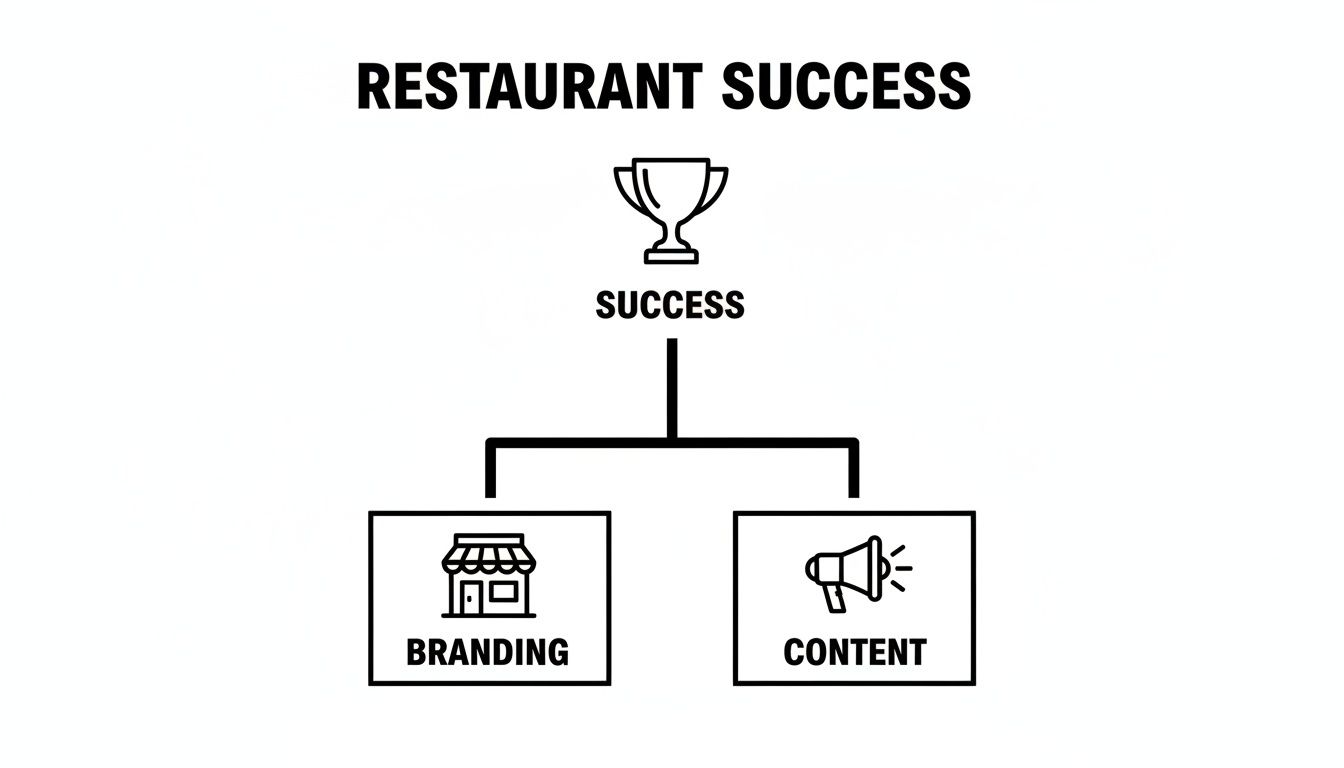
The visualization makes it crystal clear that one can't really stand without the other; your brand provides the 'what' and 'why,' while your content is how you actually deliver that message to your audience.
Think of your brand as the recipe for your signature service and your content as the well-researched guide that proves your expertise. The brand defines the value, but the content is what makes people eager to partner with you.
To help you nail down these foundational pieces, let's break down the key elements every B2B owner needs to define. Think of this as your brand-building cheat sheet.
Key Elements Of Your B2B Brand
| Brand Element | Guiding Question For Your Business | Service-Focused Example |
|---|---|---|
| Mission | Why do we exist beyond making money? | "To empower restaurant equipment suppliers with the marketing knowledge and tools they need to succeed online." |
| Vision | What do we want to become in the future? | "To be the most trusted resource for digital marketing in the restaurant equipment industry." |
| Values | What principles guide our actions and decisions? | Expertise (data-driven), Transparency (clear reporting), Partnership (client success). |
| Audience | Who are we speaking to? | Marketing managers and business owners of restaurant equipment supply websites. |
| Voice & Tone | How do we sound? | Authoritative and helpful, but also direct and results-oriented. Never confusing. |
| USP | What makes us the only choice? | "We are the only agency specializing exclusively in SEO and content services for restaurant equipment websites." |
Mapping these elements out gives you a solid foundation to build upon.
Ultimately, a well-defined brand acts as your North Star. It guides every single piece of content you create, ensuring that every blog post, case study, and service page reinforces the unique value you offer. This consistency is what builds trust and attracts the right clients—the long-term partners who will come back time and time again.
Creating Content That Builds Authority
Once you've locked down your brand's foundation, it's time for the fun part: bringing that expertise to life. This is where your branding and content marketing moves past simply listing your services. It's about creating content that truly helps your audience, making them see you as an indispensable resource. You're translating the value of your brand into insights people can use, share, and trust.
Think of every blog post, guide, or case study as a mini-consultation that demonstrates your expertise. Don't just say you offer "SEO services"—show it. A simple "We do SEO" becomes "A Step-by-Step Guide to Local Citations for Commercial Kitchen Suppliers." That level of detail proves your knowledge and builds real credibility.
From Your Expertise to Their Screens
Informative content is your most powerful weapon. Well-researched articles and helpful guides are completely non-negotiable. They're what stop your ideal clients from scrolling on LinkedIn and connect on a professional level. The goal is to make your content so valuable that people can practically solve a problem just by reading it.
Here are a few content ideas that consistently deliver for B2B service providers:
- How-To Guides: Give people a peek into your process. An article explaining how to conduct keyword research for restaurant equipment or how blogger outreach works is far more compelling than a generic service page.
- Industry Trend Analysis: Tell the story of what's next in restaurant marketing. A blog post on the rise of AI in copyrighting or the future of local search builds authority and shows you're ahead of the curve.
- Case Studies: Pick a successful client and give their story the spotlight. Dedicate a post to the challenges they faced, the solutions you provided, and the results you achieved. This gives your services personality and provides social proof.
Your content has one simple job: make potential clients feel like they're seriously missing out if they don't work with you. Every post should be another reason why your agency is the only answer to their marketing needs.
Video, especially, has become a must-have. A whopping 91% of brands are now using video in their marketing. For B2B pros, this means that creating tutorials on SEO best practices or interviewing industry experts can make a huge difference in getting noticed.
Turning Customers into Your Best Storytellers
Finally, never underestimate the power of your own clients. Actively encourage them to share testimonials and case studies. When you foster genuine feedback, you start to understand what it takes to get restaurant reviews that drive bookings.
This user-generated content is pure gold—it’s social proof that reinforces everything your brand promises with every glowing comment and positive review. Check out these proven content marketing examples to see how others are crushing it with these very same ideas.
Choosing Where to Share Your Story
Creating expert-level content is a fantastic start, but it doesn't mean much if your ideal clients never see it. The next move in your branding and content marketing strategy is distribution—picking the right channels to get your story in front of a professional audience.
Think of it like this: your content is the perfectly researched guide to SEO. The channel is the professional journal you publish it in. The context is everything.
You don't need to be everywhere at once. The real key is to focus your energy where it will actually make a difference. For most B2B businesses, that means mastering a few core platforms that fit your brand and connect you directly with your target industry.
Master Your Digital Headquarters
Before you even think about social media, your absolute top priority should be your digital curb appeal. This is all about dominating search results when a potential client types "SEO services for equipment suppliers" into Google.
-
Your Company Blog: This is your home base, the media hub you own completely. Use it to share detailed guides on local citations, put a spotlight on successful client campaigns, or reveal the secrets behind effective copyrighting. Every single post is a new chance to rank for industry keywords and build your authority.
-
Local SEO: This is the art and science of showing up for relevant service searches. When you optimize your website and online listings, you ensure that when a potential client is looking for your expertise, your business is the first and best choice they see.
A huge piece of this puzzle is a well-managed Google Business Profile. To get this set up the right way, check out our guide on how to get a Google Business listing. Honestly, it's one of the most powerful free marketing tools a B2B service has.
Your blog and SEO efforts are the foundation of your business. They work together to make sure that when customers are actively looking for expertise like yours, they find you first.
Choosing Your Professional Networks
Once your online presence is solid, you can start amplifying your message on social media. Each platform has a different vibe and serves a different purpose, so choose wisely based on your brand’s personality.
For a business as expertise-driven as yours, platforms like LinkedIn are a no-brainer for sharing in-depth articles, case studies, and networking with industry professionals.
Facebook, on the other hand, can be amazing for building a community, sharing company updates, and running highly targeted ads to reach specific types of business owners in your niche. By picking the right channels, you can invest your time and budget for the biggest return, turning online followers into qualified leads.
Using Modern Tools to Streamline Your Marketing
You don’t need a massive marketing team or a bottomless budget to create professional-grade content that tells your company's story. Smart, accessible technology—especially Artificial Intelligence (AI)—can act as your right-hand marketing assistant. It's a way to save precious time while seriously upping the quality of your content services, from copyrighting to blog posting. We're not talking about complex code, just practical tools that lighten your workload.
Imagine having a brainstorming partner on call 24/7. AI can spit out dozens of blog post ideas about restaurant SEO, like "The Ultimate Guide to Local Citations" or "How Blogger Outreach Boosts Equipment Sales." It can also draft killer social media captions for your latest article in seconds. That frees you up to focus on what you do best: client strategy.

This kind of tech isn't just for the big corporate chains anymore. The proof is in the pudding: over 80% of marketers globally are already using AI in their strategies. Better yet, 67% of small businesses now rely on AI for their content and SEO, showing that even specialized agencies can punch well above their weight. If you want to dig deeper into the numbers, you can find more insights on AI in marketing at Typeface.ai.
Practical AI Applications for Your Business
The real magic of these tools is their efficiency. They take the repetitive, time-sucking tasks off your plate, giving you more time to perfect your client strategies and build relationships. This blend of smart technology and authentic human expertise is the winning formula for modern branding and content marketing.
Here are a few ways you can put AI to work right now:
- Content Ideation: Have an AI tool scan industry forums and competitor blogs to pull out common themes. This gives you a direct line into what your audience truly needs, handing you endless ideas for content that you know will hit the mark.
- SEO Optimization: These tools can suggest the exact keywords to sprinkle into your articles and service pages. That’s how you make it easier for potential clients searching "article writing for equipment websites" to find you first.
- Drafting & Copyrighting: No time for a first draft? No problem. AI-powered platforms can generate structured outlines or initial drafts for blog posts, social media updates, and client reports in minutes.
- Email Marketing: Quickly whip up compelling email campaigns to announce new services, share case studies, or promote your latest blog post. It’s a simple way to keep your business top-of-mind with your prospects and clients.
By automating the groundwork, AI frees you to focus on the heart of your business—delivering exceptional marketing results for your clients. It’s not about replacing your creativity; it’s about amplifying it.
Measuring What Matters Most for Your Business
Putting out fantastic content is really only half the job. If you're not tracking how it performs, you're essentially marketing in the dark. How can you tell if those in-depth SEO guides or your detailed posts on blogger outreach are actually bringing more clients through the door? This is where measuring your branding and content marketing efforts becomes absolutely essential.
Forget about getting bogged down in confusing jargon and overwhelming data dashboards. For a busy business owner, success comes down to tracking a few key performance indicators (KPIs) that directly tie back to your bottom line. You want to see a clear, undeniable line connecting your marketing activities to real-world results.
Focusing on Actionable Insights
Start by looking at the numbers that tell a story about customer behavior. The goal isn't just to count how many people "liked" a post, but to see how many took a meaningful step because of it.
Here are the essential metrics you should be watching:
- Website Traffic from Content: Using a simple tool like Google Analytics, you can see exactly how many visitors your blog posts or service pages are attracting. This shows you if your content is successfully pulling in potential clients.
- Lead Generation: Don't get caught up in traffic counts. Instead, track the number of contact form submissions, phone calls, and newsletter sign-ups. High lead generation means your content is truly connecting and building a pipeline for your business.
- Conversion Metrics: This is where the magic really happens. Keep an eye on how many people request a quote after reading a blog post or download a guide from one of your landing pages.
The ultimate measure of success is whether your content leads to tangible business outcomes. A single qualified lead that came from a well-crafted blog post is more valuable than a thousand passive views.
By zeroing in on these specific KPIs, you get a crystal-clear picture of what's working and what isn't. This data-driven approach lets you double down on the content that actually generates leads and stop wasting time and money on strategies that fall flat. To get even deeper into this topic, you can learn more about how to measure SEO performance and see the true return on your marketing investment.
Common Questions About B2B Marketing
Look, when it comes to branding and content marketing, it’s normal for service providers and business owners to have a ton of questions. Getting straight, practical answers is the only way to move forward and feel good about your plan.
Let’s tackle some of the most common hurdles you might be facing. Think of this as a quick-reference guide to reinforce the big ideas we've covered.
How Can a Small Agency Start With a Tight Budget?
Start small and, most importantly, be consistent. You absolutely do not need a massive budget to make a real impact.
Your best bet is to focus your energy on just one or two channels where you know your clients are active—LinkedIn and a professional blog are usually the top contenders. Use your industry expertise to write high-quality, helpful articles that solve your audience's problems. Free tools like Canva are fantastic for whipping up simple, eye-catching graphics for social media promotion.
The real key here is consistency. Keep publishing content that showcases your unique expertise in areas like SEO, local citations, and article writing. Even one solid blog post a month can do wonders for your industry authority over time without costing you much more than your time.
What Is the Difference Between Branding and Marketing?
It’s actually pretty simple when you break it down. Think of it like this: branding is who you are, while marketing is how you tell people about it.
Your brand is the soul of your business. It’s your mission, your values, the professional reputation you build, and that distinct expertise you're known for—like being the top expert on SEO for equipment suppliers.
Content marketing, then, is the specific stuff you do to share that identity. It's the blog posts on copyrighting, the case studies, and the social media updates you create to tell your story and attract new clients.
Branding is the foundational recipe for your business's value proposition. Content marketing is the expert-level execution and storytelling that makes clients trust your services.
How Long Does It Take to See Results?
This is a big one. Content marketing is a marathon, not a sprint. While a single social media post might give you a nice little bump in engagement, building a powerful brand and seeing a real shift in your SEO takes patience.
Realistically, you should expect to see meaningful traction in your website traffic, lead generation, and overall brand awareness within six to twelve months of consistent effort. It's all about the long game. Every single piece of content you publish is another brick in the foundation, making your online presence stronger and more authoritative over time.
For top-tier equipment that delivers the perfect smoky flavor your customers crave, explore the wide selection of commercial charbroilers at Charbroilers.com. Find the ideal model to elevate your menu at https://charbroilers.com.